FACE FORM FINDER · 4 OCTOBER 2026
Deep-Set Eyes
Two distances, one name
Two distances live in this part of the face, and they move independently. Only one of them is the distance the name refers to.
| The distance | Between which two points | What it reads | In the listed checks |
|---|---|---|---|
| Brow to lid | the lower edge of the brow hair, and the upper eyelid crease | where the brow bone sits | brow-based reference in the listed checks |
| Socket rim to cornea | the outer rim of the eye socket, and the front of the cornea | where the eyeball sits | not used by the listed checks |
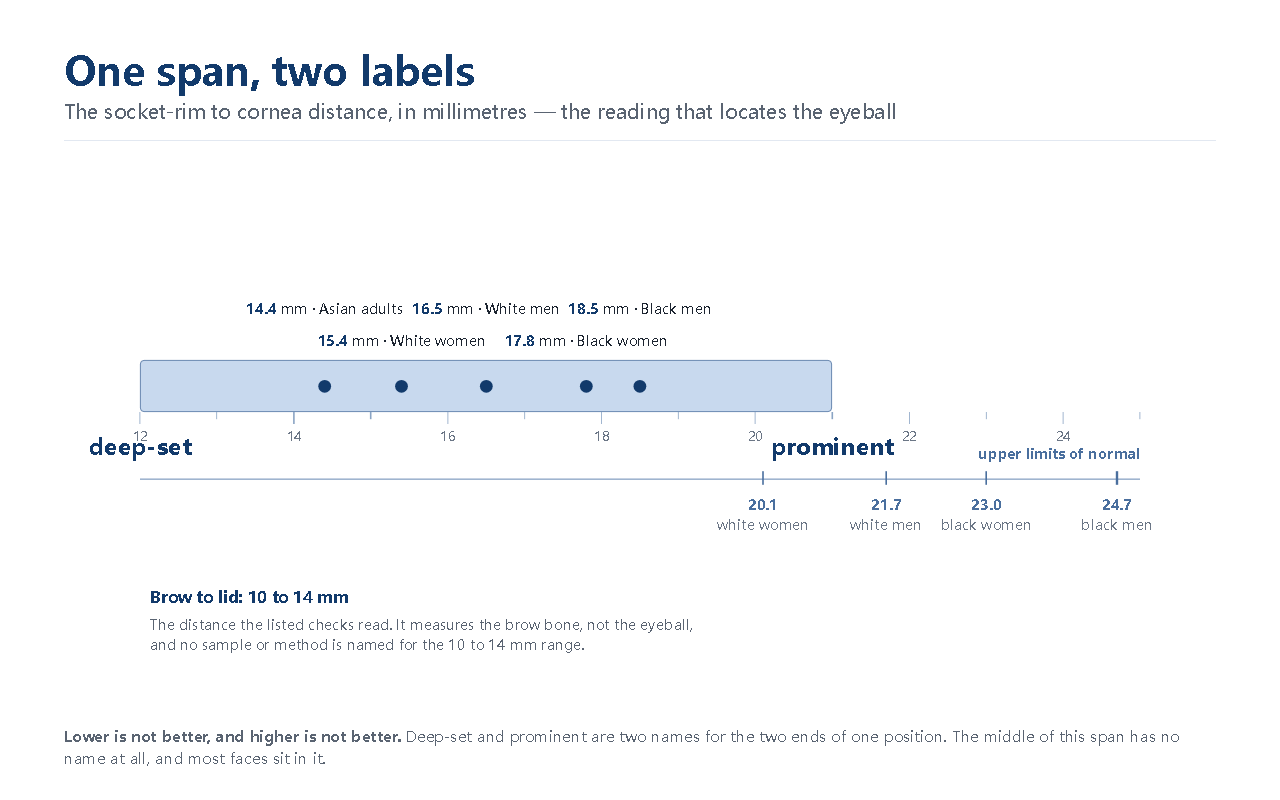
The listed checks do not give a socket-rim-to-cornea reading. The one millimetre range used in the comparison is the first distance — the space from the lower edge of the brow hair down to the upper eyelid crease, given as 10 to 14 mm in women, and under 10 mm for deep-set eyes. It is the brow distance measured more carefully than anything else in the listed set, and it is still the brow. The page that gives it does not name a sample size or method.
The distance that does measure the eye
The second distance is the one clinicians use, and it is simple enough to state in a line: the eye is held in its forward-looking position, one line is drawn through the outer rim of the socket, another through the front of the cornea, and the gap between the two lines is the reading. Millimetres. That is the whole measurement.
| Group | Mean reading | Upper limit of normal |
|---|---|---|
| Adults, the span usually quoted | 12 to 21 mm | — |
| Asian adults | 14.4 mm, ranging 8 to 20 | — |
| White women | 15.4 mm | 20.1 mm |
| White men | 16.5 mm | 21.7 mm |
| Black women | 17.8 mm | 23.0 mm |
| Black men | 18.5 mm | 24.7 mm |
The group means sit 4.1 mm apart, from 14.4 mm to 18.5 mm. The span usually quoted as normal for adults, 12 to 21 mm, is wider than that whole spread, and it is offered as one band for everybody. The men and women inside each group sit about 1 to 1.5 mm apart, so a single band wide enough to cover every group is also wide enough to swallow the difference between the sexes several times over.
What the listed checks actually read
Line the listed checks up and the pattern is plain. Six of them, and one is a number.
| The listed test | What it actually reads |
|---|---|
| A brow bone that juts forward when you turn to a three-quarter view | Brow position |
| A lid with very little space between the crease and the brow hair | Brow position |
| A shadow thrown across the upper lid by an overhead light | Brow position |
| A finger held at the outermost point of the brow bone, to see whether the eye sits behind it | Eye position, against the brow as the reference plane |
| Little or no white showing between the iris and the upper lid | Lid opening |
| The one number in the listed set, given as 10 to 14 mm | Brow position |
In this listed set, four of the six read the brow outright, one reads how far the lid opens, and one does look at the eye — but measures it against the brow bone. None of these six checks takes the rim of the socket as its plane. That is why the labels travel so freely: a test referenced to the brow will give the same eye two different names depending on the brow above it, and will give two different eyes the same name as long as their brows match.
Four boxes, two of them disagree
Put the two distances on two axes and the size of the problem stops being abstract. The brow distance is what the listed checks read. The socket distance is what the name means.
| Brow bone | Eyeball sits forward | Eyeball sits back |
|---|---|---|
| Juts forward | Brow check: deep-set. Socket distance: prominent. | Brow check: deep-set. Socket distance: deep-set. |
| Sits flat | Brow check: prominent. Socket distance: prominent. | Brow check: prominent. Socket distance: deep-set. |
The listed checks classify the brow-linked rows. The socket distance reads the columns. In two of the four boxes the two answers point opposite ways, and the listed checks do not identify which box a face occupies. A face with a heavy brow and a forward-set eye can be called deep-set by a brow-led check and read at the prominent end of the other distance. A face with a flat brow and a recessed eye can do the reverse.
Children read lower
The distance also moves with age before it settles. On the same measurement, the mean runs 13.2 mm under four years old, 14.4 mm from five to eight, 15.2 mm from nine to twelve, and 16.2 mm from thirteen to seventeen, with no difference between boys and girls. A reading taken from a child sits below most of the adult group means, so a single adult band applied to a child is measuring the child’s age as much as the child’s face.
When to stop
- Stop when the test reads the brow and the claim is about the eye. A brow test answers a brow question. It cannot tell you where the eyeball sits, because the two distances move separately.
- Stop when a number arrives without its two points. A distance is two points and a gap. If the entry names the gap but not the points, you have a figure you cannot repeat on your own face.
- Stop when one band is quoted for everyone. The group means here span 4.1 mm, and a single band wide enough to hold them all is wider than the male-to-female difference the same tables report.
- Stop when only one eye is measured. In a reference sample of 681 adults, no one had more than 2 mm of side-to-side difference. A one-eye reading cannot show whether that difference is present.
- Stop when the label is treated as a shape. Deep-set and prominent are two ends of one position. The middle of that span has no name at all, and most faces sit in it.
The two distances, the group means and upper limits, the tests and what each one reads, and the four boxes, as a CSV.
The two distances on one card
Questions
What are deep-set eyes?
Deep-set eyes are the low end of a distance taken from the outer rim of the eye socket to the front of the cornea, in the forward-looking position. Adults run 12 to 21 mm on that distance, and the group means sit between 14.4 mm and 18.5 mm. The name describes where the eyeball sits, not how the brow above it looks.
Are deep-set eyes the same as hooded eyes?
No, and the difference is the same one this page keeps coming back to. Hooded describes the upper lid skin folding down over the crease. Deep-set describes the position of the eyeball in the socket. Both reduce the visible lid, which is why they get used together, but they are read on different distances and a face can have either one without the other.
Can a face be deep-set and prominent at the same time?
It can score at both ends of the two distances at once, because the brow and the eye move independently. A heavy brow over a forward-set eye reads deep-set on every listed brow-based check and sits at the prominent end of the socket distance. That is one of the two boxes in the grid above where the two answers point opposite ways.
How do you tell if you have deep-set eyes?
Not with a brow test. Turn to a three-quarter view and look at where the eyeball sits relative to the outer rim of the socket, not relative to the brow hair. The tests that only look at the brow — a jutting ridge, a shadow under an overhead light, a small gap between crease and brow — will call a face deep-set whether the eye is set back or not.
Related guides
- Eye Shape Chart — the seven eye readings in millimetres, and the one thing that chart says it does not record.
- Facial Width to Height Ratio — one width, and the four different places the results put the line at the top of the height.
- Midface Ratio — a fixed face run through every denominator in play.
- Facial Ratios — what happens to a reading when the same face is measured to two different endpoints.
- Face Shape Chart — the thirds of the face, and how to check them at home with a soft tape.
- Jawline Shape — the three jaw readings, and how far the sample spread runs.