FACE FORM FINDER · 4 OCTOBER 2026
Midface Ratio
The numerator is agreed. The denominator is not
The pages that rank for this term are a mixed shelf: several calculators, one long article, a surgeon’s guide, a forum thread and a video. Read them together and the top half of the fraction is stable. Almost all of them divide by the span between the pupils, or by a width that stands in for it. The bottom half is where they part company, and they part in four different directions.
| Page | On top | Underneath |
|---|---|---|
| The Face Report | the brow ridge to the base of the nose | the visible face height |
| Symmi | the pupil span | the height from the pupil line to the top of the upper lip |
| Maxxiniq | the interpupillary width | the length from the pupil line to the top of the upper lip |
| Perfect Corp | the midface length, pupil line to the top of the upper lip | the interpupillary distance |
| Face Shape Detector | the pupil span | the distance from the base of the nose to the top of the upper lip |
| The Facet | the middle third, brow to nose base | the upper and the lower third |
Two of those write the fraction the other way round. That reversal only bites on a face where the two distances differ; on a face where they are equal, the reciprocal of the answer is the answer. The larger split is elsewhere. One page divides by a distance that runs from the base of the nose to the top of the upper lip, and then states that a value near 1.0 is typical. Those two statements cannot both hold on any ordinary face, because the distance from the base of the nose to the upper lip is a small fraction of the span between the pupils. The table below shows what it produces.
One fixed face, every denominator on the first page
To compare those fractions you need one face that never changes. The distances below are a fixed reference set in millimetres, assembled so the arithmetic can be checked rather than trusted. It is a defined reference, not a person, and a real face will not land on these numbers.
| Distance | mm |
|---|---|
| Hairline midpoint to brow ridge (upper third) | 62 |
| Brow ridge to base of the nose (middle third) | 61 |
| Base of the nose to chin tip (lower third) | 62 |
| Hairline midpoint to chin tip | 185 |
| Brow ridge to chin tip | 123 |
| Pupil centre to pupil centre | 62 |
| Pupil line to the top of the upper lip | 62 |
| Base of the nose to the top of the upper lip | 15 |
| Cheekbone to cheekbone | 118 |
Every fraction above is now a division between two rows of that table. Nothing else is needed, and nothing about the face changes from one line of the next table to the next.
| Sum | Result |
|---|---|
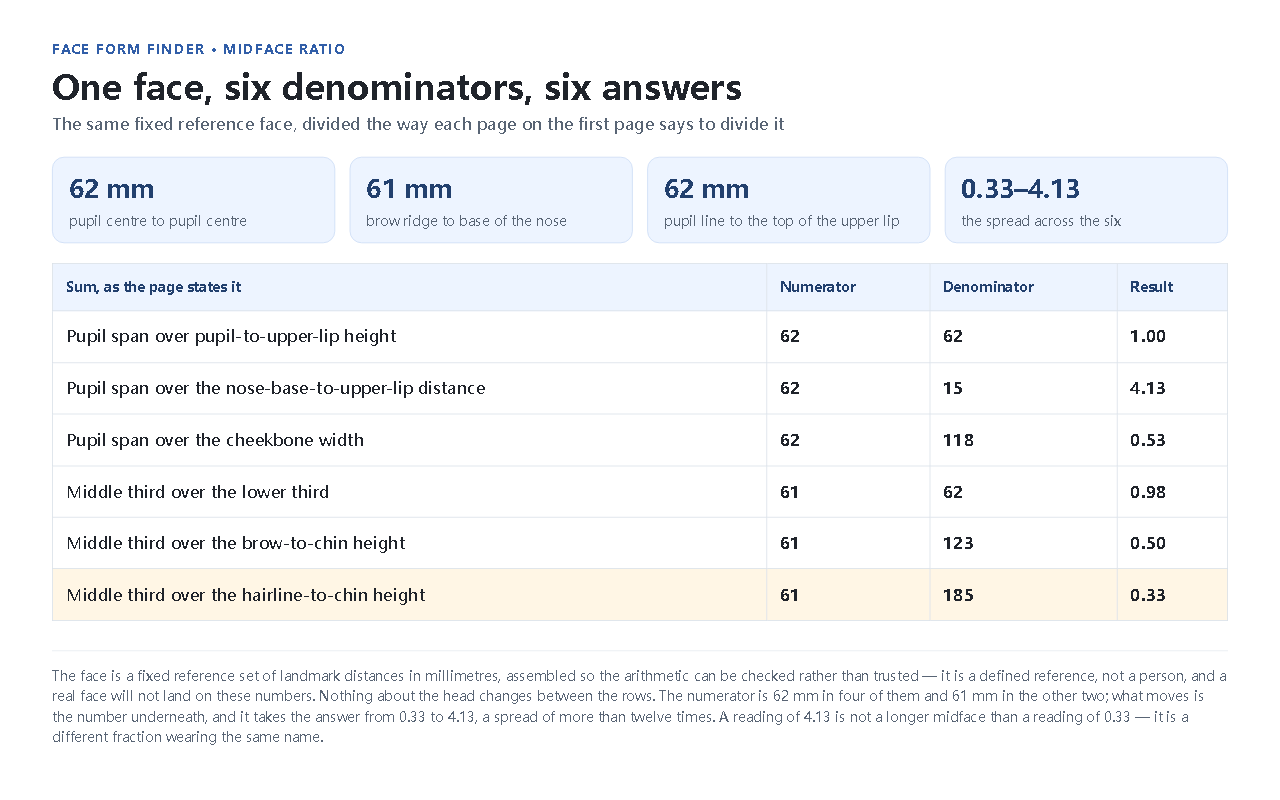
| 62 ÷ 62 — pupil span over the pupil-to-upper-lip height | 1.00 |
| 62 ÷ 15 — pupil span over the nose-base-to-upper-lip distance | 4.13 |
| 62 ÷ 118 — pupil span over the cheekbone width | 0.53 |
| 61 ÷ 62 — middle third over the lower third | 0.98 |
| 61 ÷ 123 — middle third over the brow-to-chin height | 0.50 |
| 61 ÷ 185 — middle third over the hairline-to-chin height | 0.33 |
The same numerator over two heights
Take the middle third on its own. On this face it is 61 mm, and it is the numerator of the last two rows above. Divide it by the visible face height and the answer depends entirely on where the visible part starts. Read from the hairline down to the chin tip and the sum is 61 ÷ 185 = 0.33. Read from the brow ridge down to the chin tip and it is 61 ÷ 123 = 0.50. The numerator never moved; only the top of the measurement did.
One page on the first page uses the visible face height as its denominator and states, on the same page, that its landmarks cannot see the hairline. That is not a contradiction in the page so much as a fork in its own definition: the same tool carries both readings above, and which one you get depends on where its window starts. It is also why its typical band sits a long way from the bands of the pages that divide by the pupil span — it is measuring a different pair of distances under the same two words.
Move the line and the answer moves
Of the two distances in the common fraction, one is found and one is placed. The pupil span is found. The pupil line — the horizontal you drop from the eyes down to the top of the upper lip — is placed, and the answer follows wherever you put it. On the fixed face it sits 14 mm below the brow ridge. Move it 10 mm in either direction, leave every other distance alone, and the ratio crosses most of the band that these pages treat as balanced.
| Where the pupil line sits | Pupil line to upper lip | 62 ÷ that |
|---|---|---|
| 4 mm below the brow ridge | 72 mm | 0.86 |
| 14 mm below the brow ridge | 62 mm | 1.00 |
| 24 mm below the brow ridge | 52 mm | 1.19 |
That is the whole of the fragility. A measurement that can be moved by where the measurer puts a line is not a property of the face; it is a property of the reading. Write down where you put it, or the number does not survive the next person who takes it.
The bands do not agree either
| Page | Band |
|---|---|
| The Face Report (midface height share) | 0.38–0.44 |
| The Face Report (midface ratio, as described on its calculator page) | about 0.9–1.1 |
| Symmi | 0.95–1.15 |
| Maxxiniq | 0.95–1.05 |
| Face Shape Detector | about 1.0, within ±20% |
| Perfect Corp | 1:1:1, or 1:1.618 |
The fixed face reads 1.00. That lands inside four of those bands and outside the fifth, and the fifth is not measuring the same pair of distances, which is why it sits somewhere else on the number line entirely. A band is only a band for the fraction printed next to it, and the same page can carry two bands at once when it carries two fractions.
What the number cannot do
- It does not say why. A low reading can come from a taller midface, a narrower pupil span, or both at once, and the number is identical either way. The ratio reports the outcome and hides the cause.
- It does not measure the profile. A front-on reading has no depth in it. A midface that recedes and one that sits flat can carry the same front-on ratio, because the distance being measured is in the plane of the picture.
- It does not describe a person. It describes one photo of a person, taken at one angle, one distance and one size, on one day.
- It does not travel between pages. Two numbers are comparable only when both were built from the same top distance, the same bottom distance, the same units and the same capture. Match all four or treat the two numbers as unrelated.
When to stop
- Stop when a page never prints its denominator. A midface ratio with no bottom distance attached is not a measurement you can compare with anything. Write it down as that page’s own output and go no further with it.
- Stop when the two distances are in different units. Pixels over millimetres is not a ratio. Both distances have to be in the same unit, and if that unit is pixels, the answer holds for that photo at that size and not for the face.
- Stop when the pupil line was not levelled. A head rolled to one side tilts the line the bottom distance is measured from. Level the line first, then drop the measurement.
- Stop comparing readings taken at different camera distances. Step closer to the lens and the whole fraction shifts while the head stays exactly as it was.
- Stop at a single number from a single page. If a page hands you a score with no fraction underneath it, there is nothing left to check and nothing worth carrying to the next page.
The fixed reference face, the six divisions, the three pupil-line placements and the bands, as a CSV.
The six answers on one card
Questions
What is a good midface ratio?
There is no single answer, because the band depends on the fraction. On the fixed face above, a value of 1.00 sits inside four of the six bands on the first page and outside the other two, and nothing about the face changed. A useful question is narrower: a good value for which denominator? If the page does not print one, the band it quotes is not something you can hold your own reading against.
Is 1.5 a good face ratio?
1.5 is not a midface ratio. It is the kind of number that comes out of a different fraction entirely — a face length divided by a face width, compared with a target near 1.618. A midface ratio on the common definition is a pupil span over a vertical height, and on the fixed face it reads 1.00. The two numbers live on different scales and dividing one by the other means nothing. When a page puts both under one heading, the number it hands back cannot tell you which fraction produced it.
Can you change your midface ratio?
The reading changes whenever the reading changes — a different pupil line, a different unit, a different camera distance. What it does not do is change because the face changed, in either direction. It is a proportion between fixed landmarks, not a state of the tissue, and a taller or shorter number is a description of the measurement rather than of the face. Anyone who offers to move it is moving one of the two distances or the place the line was drawn, and both of those are things you can check.
How is the midface ratio different from facial thirds?
The thirds divide the whole face into three vertical bands and describe each as a share of the total; the midface ratio takes two distances and divides one by the other. They overlap in the middle of the face, which is why one page can carry both under similar names. The test is the same as everywhere else on this page: find the two distances, in the same unit, and see whether the number you were given could have come from any other pair.
Related guides
- Facial Ratios — what happens to a reading when the same face is measured to two different endpoints.
- Facial Width to Height Ratio — the same problem one level up: the width is agreed and the line at the top of the height is placed four ways.
- Face Shape Chart — the thirds of the face, and how to check them at home with a soft tape.
- Golden Ratio Face — the measurement to compare before the score.
- Face Symmetry Test — the other proportion reading, and where it stops.
- Eye Shape Chart — the eye width and the pupil distance, in millimetres.
- Square Face Shape — jaw width against pupil distance, with the error each reading carries.