FACE FORM FINDER · 6 OCTOBER 2026
Face Shape Chart
Measure the same four points, then read the pattern. This chart deliberately gives no ratio bands or “ideal” numbers of its own.
| Face shape | Forehead width | Cheekbone width | Jaw width | Face length | How to read the pattern |
|---|---|---|---|---|---|
| Round | Close to the other two widths | Close to the other two widths | Close to the other two widths | Does not clearly lead the four readings | Four values alone do not separate round from square. Check whether the visible jaw and outline look soft rather than angular. |
| Square | Close to the other two widths | Close to the other two widths | Close to the other two widths | Does not clearly lead the four readings | Four values alone do not separate square from round. Check whether the jaw corners and outline look more defined. |
| Oval | Changes gently toward the jaw | No single width is the key signal | Gently tapered rather than widest | Longer-reading profile | The four readings can flag a long profile, but they cannot reliably decide oval versus oblong on their own. |
| Oblong | Relatively close to the other widths | Relatively close to the other widths | Relatively close to the other widths | The largest displayed measurement | The tool labels this a long profile. Keep “oblong” provisional unless the visible sides also read straight rather than gently tapered. |
| Heart | The largest displayed width | Narrower than the forehead | Narrower lower face | Read after finding the widest horizontal point | A forehead-led pattern produces the tool’s heart-profile tendency. |
| Diamond | Narrower than the cheekbones | The largest displayed width | Narrower than the cheekbones | Read after finding the widest horizontal point | A cheekbone-led pattern produces the tool’s diamond-profile tendency. |
| Triangle | Narrower upper face | Not the largest displayed width | The largest displayed width | Read after finding the widest horizontal point | A jaw-led pattern produces the tool’s triangle-profile tendency. |
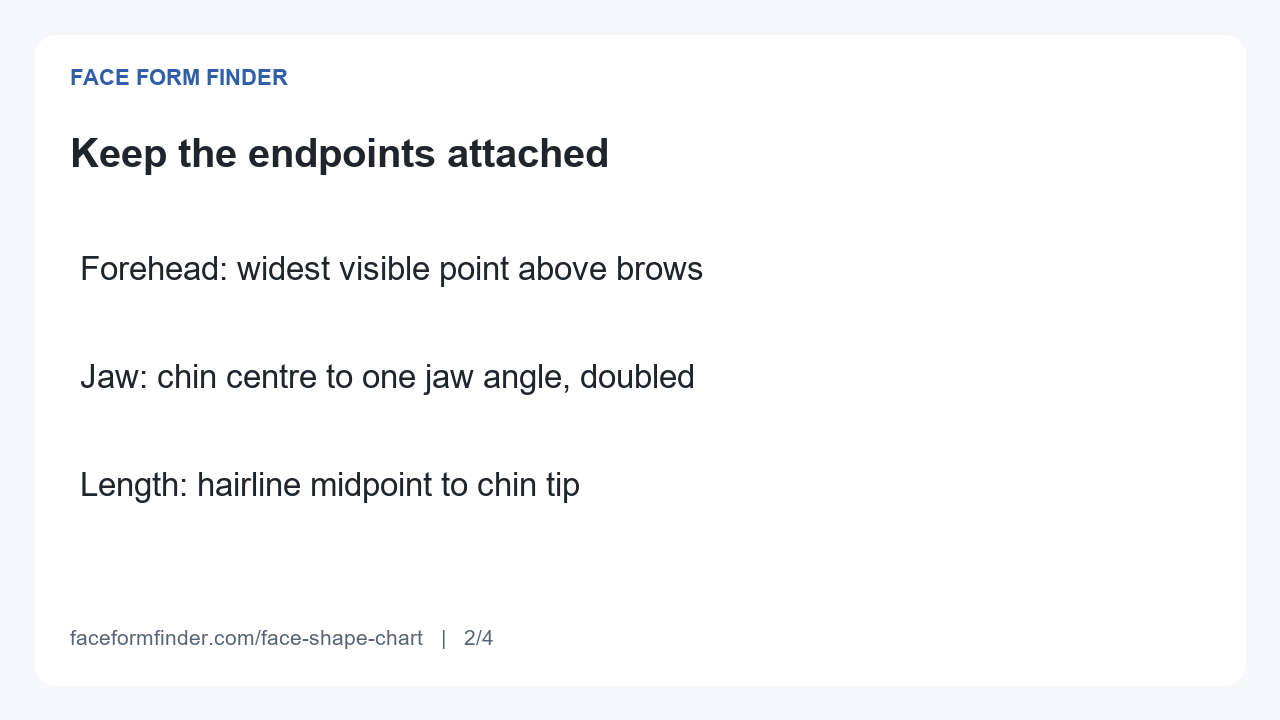
Forehead: straight across the visibly widest point between hairline and brows. Cheekbones: straight across the outermost cheekbone points, not the lower cheek. Jaw: measure from chin centre to one jaw angle below the ear, then double that reading. Face length: from the centre of the hairline to the chin tip.
Read the chart in this order
- Take the four readings with your head level, hair pulled away from the forehead and jaw, and the same unit for each value.
- Compare forehead, cheekbone, and jaw widths. If one is clearly the widest, the chart points to heart, diamond, or triangle.
- If face length is the largest displayed measurement, keep the result as a long profile first. Do not force oval or oblong from the four readings alone.
- If the three widths stay close and face length does not lead, keep the result as a balanced profile first. Use the visible jawline only as a tie-breaker between round and square.
Use the face shape detector if you want the same four image measurements shown from a straight-on photo in your browser. If your question is whether the left and right sides of a photo repeat the same difference, use the face symmetry test first; it separates a stable photo pattern from a camera-position change.
When the chart cannot separate two labels
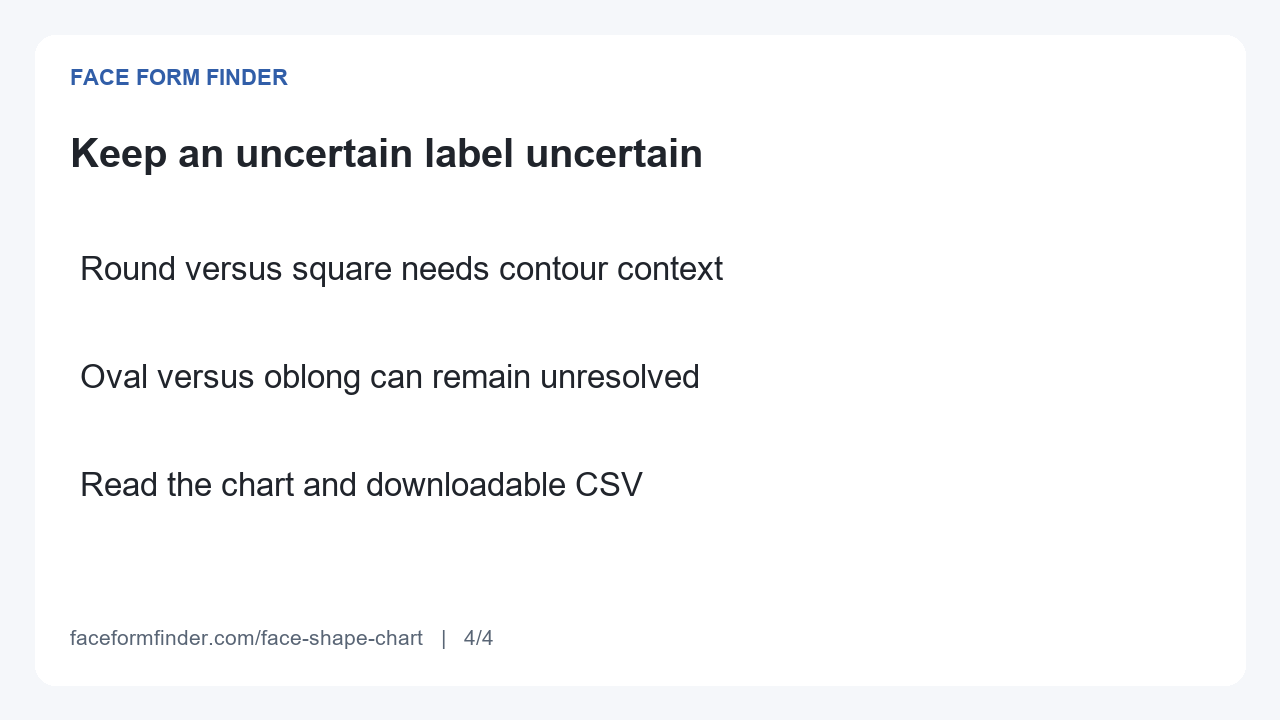
Round versus square: forehead, cheekbone, jaw, and face length describe size and width relationships. They do not record whether the jaw turns in a soft curve or at a sharper corner. Keep “round-to-square” when the outline changes with expression, camera angle, or facial fullness. The readings that separate a square face from the others, and where each of them stops being useful, are worked through on the square face shape page.
Oval versus oblong: the four measurements can show that length leads, but they do not measure the side contour that makes an outline look gently tapered or straighter. Keep “oval-to-oblong” when both readings remain plausible. For styling or glasses, test both labels instead of treating one as permanent.
Why this chart has no ratio cut-offs
This site does not use numeric face-shape ratio bands. Its detector states that there are no validated universal ratio bands for face shape, so it compares the four displayed measurements without pretending that one number creates a definitive label.
Claims that a single ideal proportion, narrow interval, or fixed width-to-length threshold can classify any face are not used here. This is a practical comparison chart, not a medical measurement standard.
What the ratio bands look like in millimetres
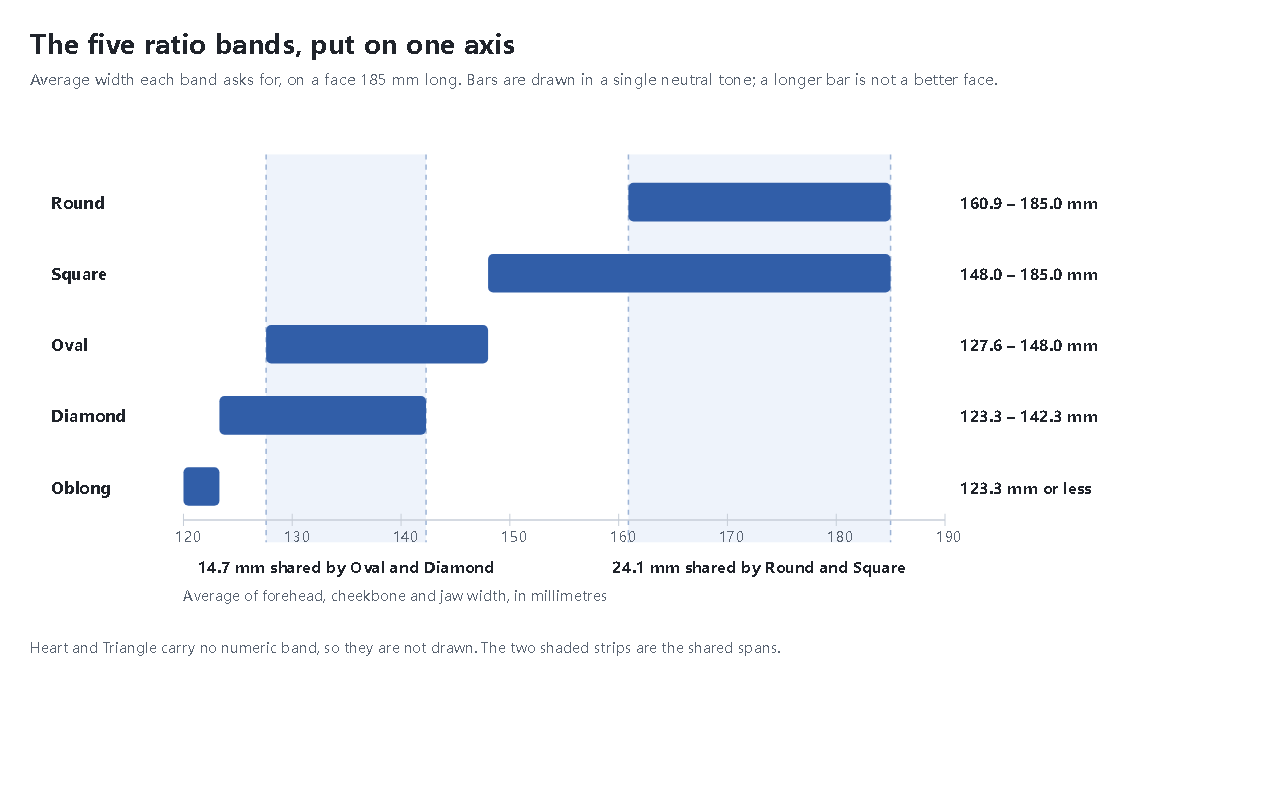
One chart on the first page for this term sorts faces with a single number: face length divided by the average of the three widths. Its bands are written as ratios. Written instead as the average width a face of a fixed length would need, each band becomes a millimetre range, and ranges can be compared with each other. The fixed length used below is 185 mm, the reference face this site measures with a tape from hairline midpoint to chin tip; change the length and each millimetre figure moves with it.
| Label | Ratio band as that chart gives it | Average width it asks for on a 185 mm face | What the band does |
|---|---|---|---|
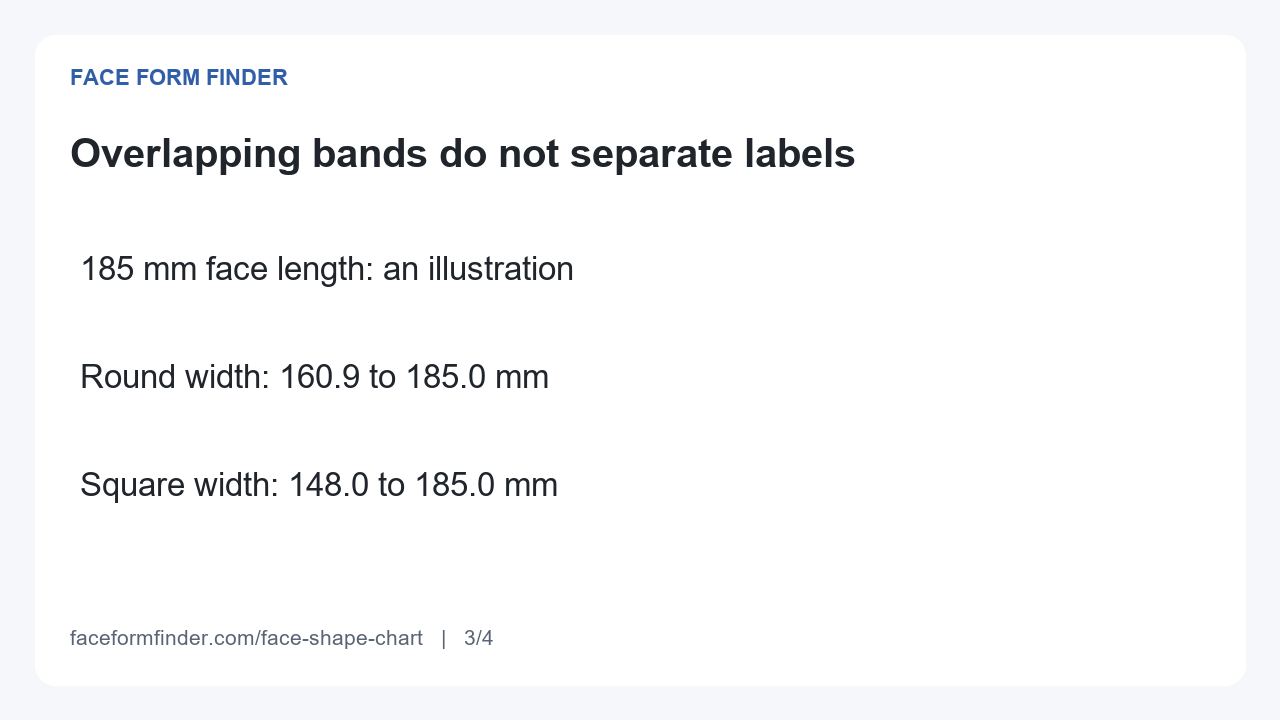
| Round | 1.0 to 1.15 | 160.9 to 185.0 mm | Overlaps the square band across 24.1 mm |
| Square | 1.0 to 1.25 | 148.0 to 185.0 mm | Runs from the oval ceiling to the longest face in the set |
| Oval | 1.25 to 1.45 | 127.6 to 148.0 mm | Overlaps the diamond band across 14.7 mm |
| Diamond | 1.3 to 1.5 | 123.3 to 142.3 mm | Shares its lower end with the oblong ceiling |
| Oblong | 1.5 and over | 123.3 mm and under | Meets the diamond band at one point and covers the rest below |
| Heart | No number given | — | Written as a forehead-to-jaw difference instead |
| Triangle | No number given | — | Written as a widest-point statement instead |
Three numbers fall out of the conversion. The round band sits entirely inside the square band, so the two share 24.1 mm of average width: a width that reads round also reads square. The oval and diamond bands share 14.7 mm of their own. Between the two overlaps there is 18.6 mm where one band applies and no second one does.
The overlaps are the part worth keeping. A single ratio cannot separate round from square, or oval from diamond, because the two labels in each pair are defined over overlapping spans of the same number. That is arithmetic on those bands, not a judgement about anyone's face, and no amount of care with the tape changes it.
Heart and triangle are the two labels with no numeric band. Both are written as statements about which of the three widths is largest, so a face inside either overlap cannot be moved by the ratio — the ratio has nothing to say about those two.
No figure here is a new cut-off. Each one is a band from that chart divided into one fixed face length, and they are what those bands look like once they are put on the same axis.
The seven labels, the ratio band that chart gives each one, the average width it asks for on a 185 mm face, and the three figures that fall out of the comparison, as a CSV. Download face-shape-chart-bands.csv
Where to stop
How to check your facial thirds at home
Facial thirds divide the face vertically into three equal bands: upper third (trichion, the hairline, to glabella, the brow ridge), middle third (glabella to subnasale, the base of the nose), and lower third (subnasale to soft-tissue menton, the chin tip). In standard anatomical naming those four points are trichion, glabella, subnasale, and soft-tissue menton; elsewhere this page calls them hairline, brow ridge, base of nose, and chin tip. The idea comes from classical proportion guides used in art and medical reference texts, not from validated universal rules.
To measure them without a caliper: use a soft tape or the edge of a card. Keep your head level and look straight ahead. Mark each transition point with a fingertip, then read the distance between the marks. Most faces do not land on exact thirds, and a difference of a few millimetres is normal.
What the reading actually tells you. If the lower third is clearly the longest, the overall profile reads longer and the face-shape detector is more likely to flag a long profile. If the upper third leads, the forehead is proportionally taller. These vertical proportions are extra context; they do not override the four horizontal measurements in the chart above.
Common measuring mistake. Measuring from the hairline after a recent haircut or with a pushed-back fringe gives a shorter upper-third reading than the true hairline. Pull hair away from the forehead and use the visible scalp edge, not the fringe line.
What one measured population found
Al-Sebaei (2015) measured the vertical thirds in 168 Saudi dental students aged 20–24 from the Arabian Peninsula, using a caliper. This is population-level evidence only. That measurement used nasion, subnasale, and gnathion as its landmarks, which is not the same set as the trichion, glabella, subnasale, and soft-tissue menton used above, so its numbers are not comparison values for your own reading.
What it reported, in millimetres. Middle third 54.12 (male) and 53.19 (female); lower third 65.02 (male) and 60.27 (female). The reported mean difference between the middle third and the lower third was n-sn = sn-gn, at −10.9 (male) and −7.1 (female).
How often the thirds came out unequal. In the same 168 Saudi students aged 20–24, the middle third read shorter than the lower third in 91.4% of males and 88% of females. Equal thirds is a classical ideal; in this measured population the thirds generally were not equal.
Where the brow line sits
The brow ridge is the boundary between the upper third and the middle third, so this page treats the brow as a landmark rather than as a feature. The distances that describe a brow itself, and the two ratios that set where its arch belongs, are in the eyebrow shape chart.
Where the hairline itself is measured
The top of each reading on this page is the hairline, so it is worth knowing that the line across the forehead has a two-part description of its own. The hairline shapes chart sets out the four shapes of the anterior hairline and the three height bands they sit in, and gives the measured share of men for the six combinations its source separates, out of 461 men with no hair loss.
Where the jaw itself is measured
The lower third of this page is the jaw, and the jaw carries three readings of its own: the gonial angle, the bigonial width, and the ramus height. The jawline shape page sets out what each one measures, the values a named sample came out at, and why the same landmark reads differently on a film and on a scan.
Questions
Why do two face shape charts give me different labels?
Because the pages ranking for this term do not use the same bands. One of them writes its bands as length-to-width ratios and adds two percentage statements on top — a forehead-led shape at 15% wider than the jaw, a cheekbone-led shape at 10% wider than both. The others carry no number. Run those against one face and the labels can disagree without either page being wrong.
Can I measure my face shape with a ruler?
You can take the four readings: forehead width at its widest point between hairline and brows, cheekbone width across the outermost points, jaw width from chin centre to one jaw angle doubled, and face length from hairline midpoint to chin tip. What the ruler cannot do is turn those four numbers into one label, because those bands overlap.
How much do those bands overlap?
On a face 185 mm long, round and square share 24.1 mm of average width and oval and diamond share 14.7 mm. Those are the two pairs that chart names as its tie-breakers, and the overlap is the reason it needs one.
Is there a printable face shape chart?
The comparison table at the top of this page and the band table below it both print cleanly. The band table is also available as a CSV if you want the numbers in a spreadsheet.
Which face shape is most common?
One chart on the first page gives shares alongside its bands, with oval leading at 28.4% and oblong second at 21.7%. Those shares describe the sample that chart worked from, not the people reading them.
Related guides
- Eye Shape Chart — the seven readings of the eye opening, in millimetres and degrees.
- Golden Ratio Face — each phi proportion written as a length, and where the reference face misses it.
- Face Symmetry Test — what a left-right reading of the same photo adds, and what a head turn adds to it.
- Eyebrow Shape Chart — the brow above the eye, measured the same way.
- Nose Shape Chart — nose features observed the same way.
- Lip Shape Chart — lip features observed the same way.
The 72-second version
If the player does not load, watch it on YouTube: Face Shape Chart: Four Readings and Where the Labels Overlap.