FACE FORM FINDER · 6 OCTOBER 2026
Eye Shape Chart: The Seven Numbers the Lists Leave Out
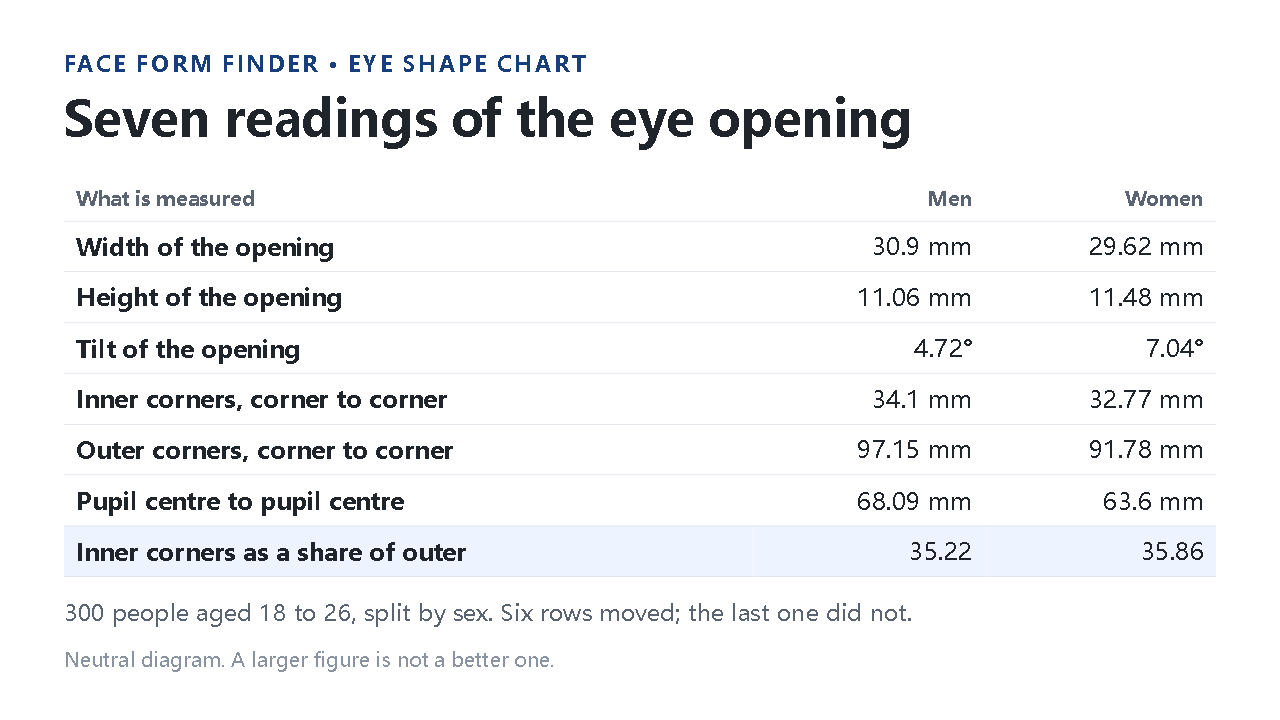
Most eye shape charts give you a list of names and one sentence about each. They give you no distance. This one does: seven readings of the eye opening, in millimetres and degrees, taken from 300 people aged 18 to 26 and split by sex.
| What is measured | Men | Women |
|---|---|---|
| Width of the eye opening | 30.9 mm | 29.62 mm |
| Height of the eye opening | 11.06 mm | 11.48 mm |
| Tilt of the eye opening | 4.72° | 7.04° |
| Inner corners, corner to corner | 34.1 mm | 32.77 mm |
| Outer corners, corner to corner | 97.15 mm | 91.78 mm |
| Pupil centre to pupil centre | 68.09 mm | 63.6 mm |
| Inner corners as a share of outer corners | 35.22 | 35.86 |
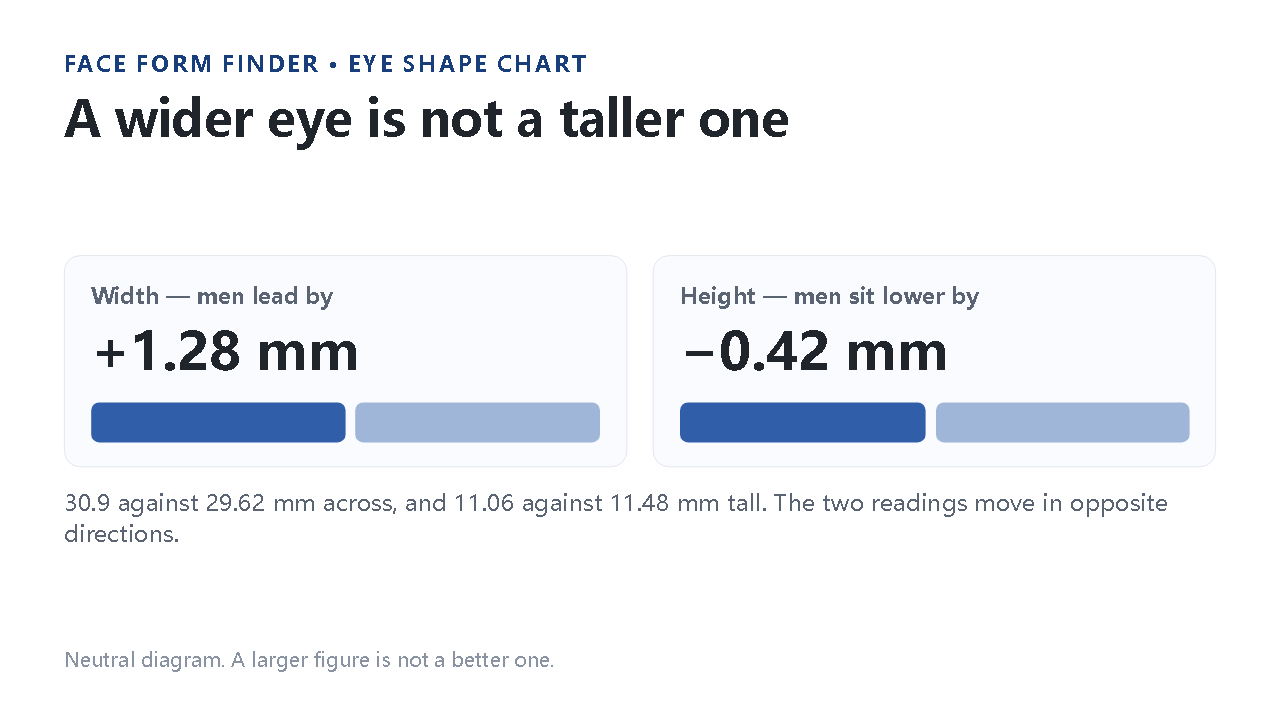
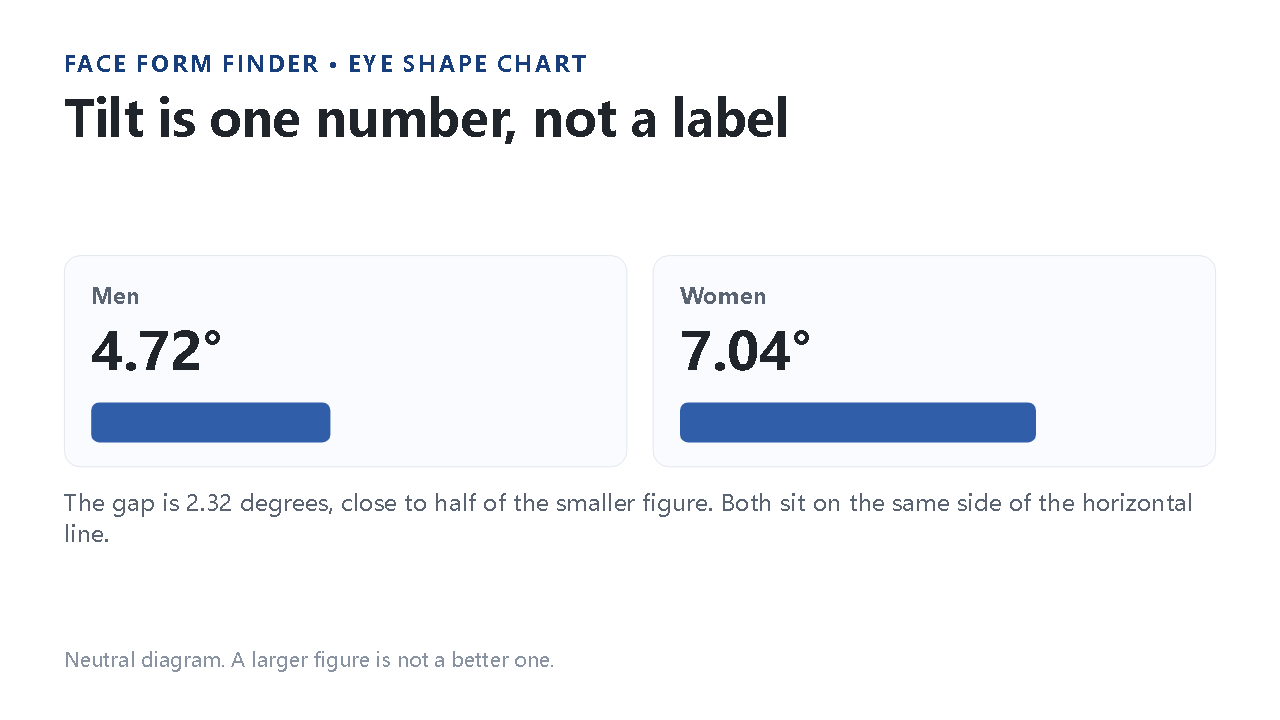
Width and height move in opposite directions. The male opening is the wider of the two by 1.28 mm and the shorter of the two by 0.42 mm, so a wider eye is not automatically a taller one. Tilt moves the most in relative terms: 4.72 degrees against 7.04 degrees, a gap of 2.32 degrees, which is close to half of the smaller figure.
The last row does not separate the sexes. Inner corners as a share of outer corners sits at 35.22 against 35.86, a gap of 0.64, and it is the row where the two sexes came out alike. The other six rows moved.
What each of the seven readings is
Six of the seven are straight distances between two landmarks you can find on your own face. The seventh is those two distances set against each other.
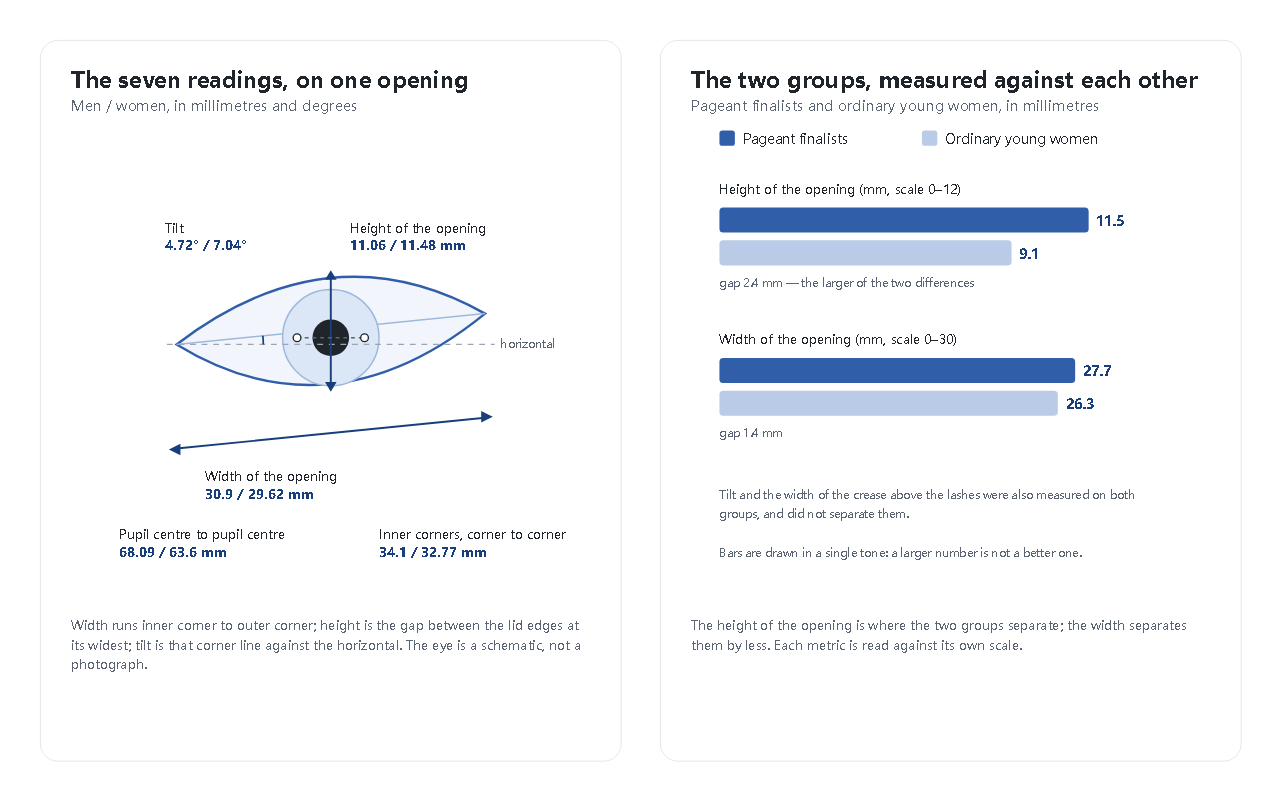
Width of the opening runs from the inner corner to the outer corner, along the line the eye closes on.
Height of the opening is the vertical gap between the upper and lower lid edges, taken at the widest point of the opening.
Tilt is the angle the inner-to-outer corner line makes against the horizontal. It is measured in degrees, unlike the other six.
Inner corners, corner to corner is the span between the two inner corners, across the bridge of the nose.
Outer corners, corner to corner is the same span at the temple end, across the whole face.
Pupil centre to pupil centre is measured from the middle of one pupil to the middle of the other.
Inner corners as a share of outer corners is the inner-corner span divided by the outer-corner span and multiplied by 100. It was worked out for each person and then averaged, so it comes with a spread of its own (plus or minus 4.16 for the men, 4.44 for the women) and it does not match the two averages above divided by each other: 34.1 over 97.15 gives 35.10, and 32.77 over 91.78 gives 35.70, against the 35.22 and 35.86 printed here. An average of ratios is not the ratio of averages. It says how wide-set an eye is against the face it sits on, rather than how big the eye is.
Why tilt is the reading shape lists get wrong
Shape lists describe tilt with a word. A corner that lifts, a corner that drops, a corner that sits level — three or four options, and that is as far as it goes.
Measured, the same thing is one continuous number. In the table above it is 4.72 degrees for men and 7.04 degrees for women. Those are small angles, and both were recorded on the same side of the horizontal reference line, so the two sexes differ here in how far the angle runs rather than in which direction it runs. A list sorting eyes into lifts and drops is drawing a line through that range and then naming the two ends of it.
The consequence is that the label carries less weight than it appears to. Two eyes can both be called lifted and sit 2 degrees apart, which is most of the gap between the male and female averages.
What separated two groups measured against each other
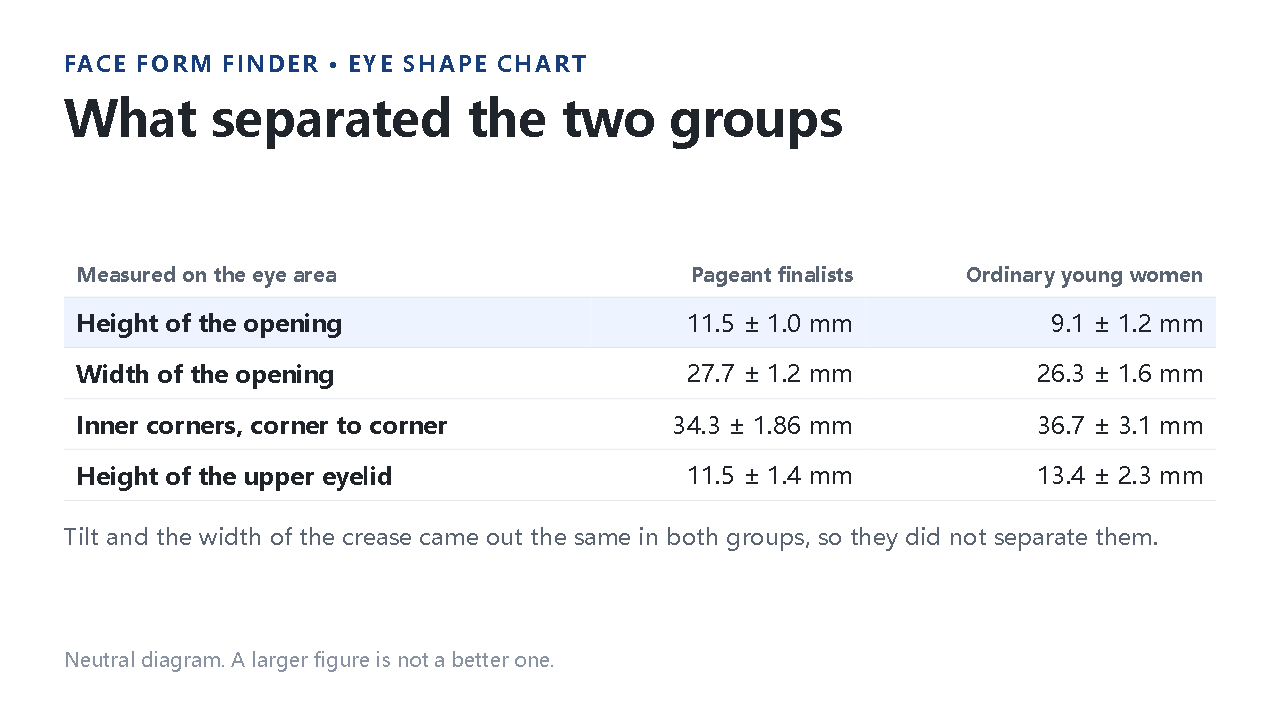
A second set of readings was taken from two groups of young women of the same ancestry, one made up of national beauty pageant finalists and one of ordinary young women, measured with three-dimensional photogrammetry.
| Measured on the eye area | Pageant finalists | Ordinary young women |
|---|---|---|
| Width of the eye opening | 27.7 ± 1.2 mm | 26.3 ± 1.6 mm |
| Height of the eye opening | 11.5 ± 1.0 mm | 9.1 ± 1.2 mm |
| Inner corners, corner to corner | 34.3 ± 1.86 mm | 36.7 ± 3.1 mm |
| Height of the upper eyelid | 11.5 ± 1.4 mm | 13.4 ± 2.3 mm |
Two more things were measured on the same groups and came out the same in both: the tilt of the eye opening, and the width of the crease above the lashes. Neither separated them.
So the two readings that shape writing leans on hardest are the two that did not move. What did move is the height of the opening — 11.5 mm against 9.1 mm, a gap of 2.4 mm, which is just over a quarter of the smaller figure and well above the 1.4 mm that separates the two groups on width. The inner corner span moved the other way, 34.3 mm against 36.7 mm.
Why the same label carries different millimetres
The eye opening in the first table measures 30.9 mm across in men. In the second table it measures 26.3 ± 1.6 mm across. Both are real readings of the same distance.
Those two figures come from two different groups, of different ancestry, measured by two different methods — standardised photographs in one case and three-dimensional photogrammetry in the other. So the difference between them cannot be quoted as one clean number.
What it does show is the thing worth carrying away: a millimetre figure for an eye belongs to the group it was taken from. Any chart that gives you one number for an eye shape without telling you who was measured has left out the part that decides whether the number applies to you.
The names, read as ratios
The eight labels that turn up on most eye shape charts are shorthand for relationships between the readings above, not separate categories.
An eye that reads as almond is one where the width clearly leads the height. At 30.9 mm across and 11.06 mm tall, the height is a little under 36 percent of the width. At 29.62 mm and 11.48 mm it is a little under 39 percent. Both are arithmetic on the first table, not separate measurements.
An eye that reads as round is one where that share climbs. Hooded and monolid describe how much of the upper lid stays visible, which is the upper eyelid height row in the second table. Upturned and downturned are the tilt row read at its two ends. Deep-set and prominent describe depth, which the seven readings above do not record.
That is why one eye can carry two labels at once without any contradiction. Corner direction and lid visibility are two different rows.
Where the numbers come from, and where they stop
The seven readings are averages from 300 people aged 18 to 26 of Malaysian South Indian ancestry, measured on standardised photographs with computer software. Six of the seven rows came out significantly different between the sexes; the last did not.
The four readings in the second table come from 43 pageant finalists and 48 ordinary young women of Korean ancestry, measured with three-dimensional photogrammetry.
Both sets are narrow in the same direction. Each person measured was young, and each set covers one ancestry. A figure from either table is not a value for people outside that age range or outside that group.
When to stop
The seven readings by sex, the four readings from the two-group comparison, the arithmetic that connects them, and the stop rules, as a CSV.
The seven readings on one eye
Questions
How do I find my eye shape from a chart?
A chart sorts eyes by the shape of the opening, the direction of the corners and how much of the upper lid stays visible. Read those three on a straight-on photo, then use the numbers above to see how far apart two named groups sit in millimetres rather than as words.
What is the most common eye shape?
Almond is the label most charts put first, and it is where the width leads the height. On the 300-person set here, the opening is a little under 36 percent as tall as it is wide in men and a little under 39 percent in women, which is where that label sits numerically.
Do eye shape charts use measurements?
The ones that rank for the term mostly do not. In the pages that hold the top spots, the tables list words such as crease and corner tilt, and the millimetre columns are absent. The seven readings here are the ones those tables leave out.
Can two people with the same eye shape have different measurements?
Yes. The same distance reads 30.9 mm in one group and 26.3 mm in another, and the two groups differ in ancestry and in the method used. A figure belongs to the group it was measured in, not to the label.
Does eye shape affect eye health?
An eye health page frames shape as a risk factor for dryness or irritation. That is a separate question from the seven distances here, and a change that is new, one-sided, painful, or that affects vision needs a clinician rather than a chart.
Related guides
- Canthal Tilt — the tilt of the eye opening, read on its own.
- Eyebrow Shape Chart — the brow above the eye, measured the same way.
- Deep-Set Eyes — the distance that does record depth, and why a brow test cannot stand in for it.
- Face Shape Chart — the four readings that build a face shape from the brow ridge down.
- Nose Shape Chart — nose features observed the same way.
- Lip Shape Chart — lip features observed the same way.
- Face Symmetry Test — what a left-right reading of the same photo adds.
The 82-second version
If the player does not load, watch it on YouTube: Eye Shape Chart: The Seven Numbers the Lists Leave Out.