FACE FORM FINDER · 8 OCTOBER 2026
Canthal Tilt
The tables below are worked out from that geometry, and the arithmetic is left visible so it can be repeated. This page is about reading the angle off a photograph and about the bands other pages print. It is not about which angle is preferable, and a number here is a direction and a size rather than a score.
The angle is a rise over a run
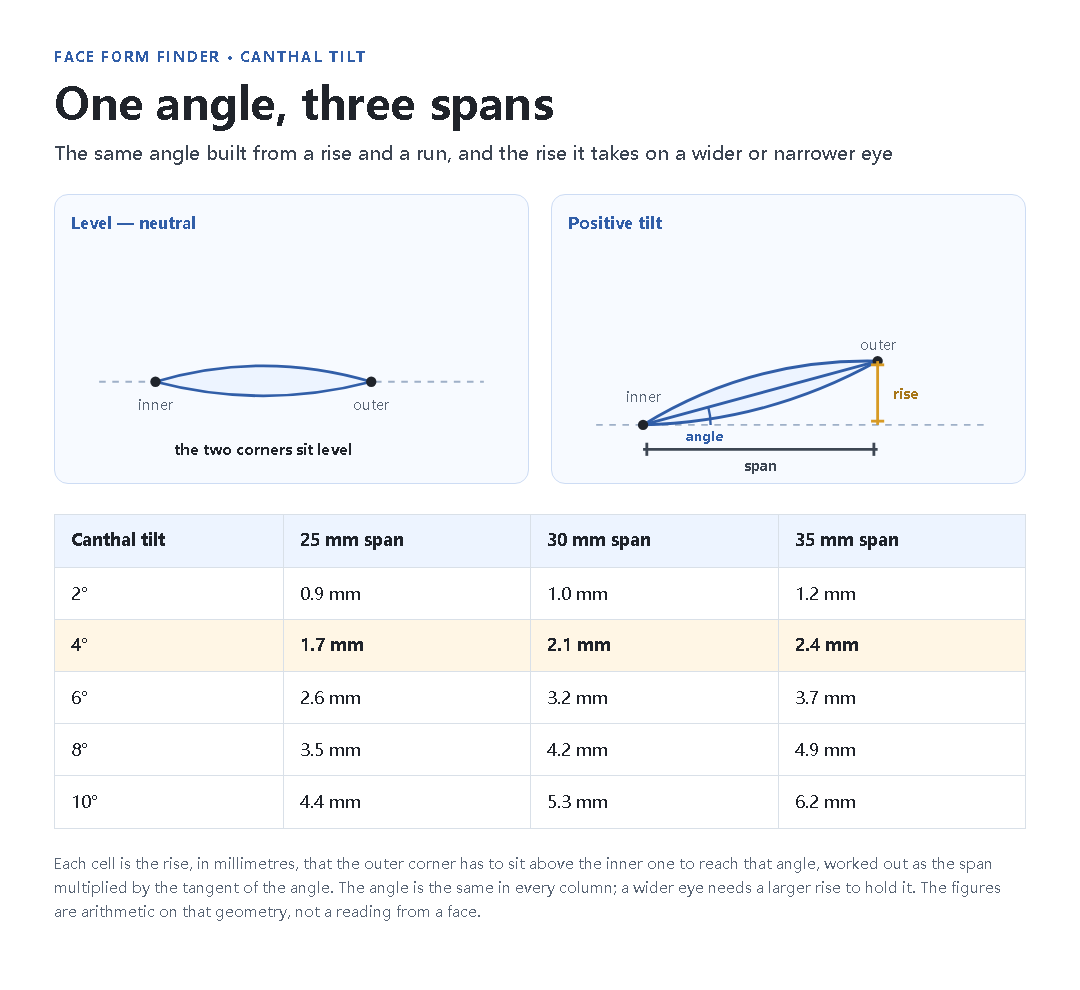
Draw a line from the inner corner of the eye to the outer corner. If the outer corner sits above the inner one the tilt is positive; if it sits below, negative; level is neutral. The size of the tilt is the angle that line makes against the horizontal.
Two lengths set that angle: how far apart the two corners sit across the face, and how far one sits above the other. The first is the run, the second is the rise, and the angle is the rise over the run.
The rise that gives each angle
Read down for the angle and across for the span between the two corners. Each cell is the rise, in millimetres, that the outer corner has to sit above the inner one to reach that angle.
| Canthal tilt | 25 mm span | 30 mm span | 35 mm span |
|---|---|---|---|
| 2° | 0.9 mm | 1.0 mm | 1.2 mm |
| 4° | 1.7 mm | 2.1 mm | 2.4 mm |
| 6° | 2.6 mm | 3.2 mm | 3.7 mm |
| 8° | 3.5 mm | 4.2 mm | 4.9 mm |
| 10° | 4.4 mm | 5.3 mm | 6.2 mm |
The whole table is worked out on 2026-10-08 from the span multiplied by the tangent of the angle. A wider span needs a larger rise for the same angle: 4 degrees is 1.7 mm on a 25 mm span, 2.1 mm on a 30 mm span and 2.4 mm on a 35 mm span.
Working it backwards from a photograph
On a photograph the two lengths are what you can measure and the angle is what follows. On a 30 mm span, a rise of 1 mm is 1.9 degrees, 2 mm is 3.8, 3 mm is 5.7, 4 mm is 7.6 and 5 mm is 9.5. Each of those is the angle whose tangent is the rise over the span, worked out here rather than read off a page.
Because the span is the denominator, the same rise gives a smaller angle on a wider eye. A 2 mm rise is 4.6 degrees on a 25 mm span and 3.3 degrees on a 35 mm span. Two people can measure the same 2 mm and sit at angles more than a degree apart.
The bands the pages on the first page print
Three of the pages on the first page for this term put a number on the angle. They do not put the same kind of number on it.
| Page on the first page | What it puts on the angle |
|---|---|
| QOVES | men 0° to +4°, women +2° to +8°, and a typical range of 0° to +10° |
| wikiHow | an ideal of 5° to 8°, and up to 15° for women |
| A measured set of 42 faces | women 8.50° ± 2.10°, men 6.51° ± 2.67°, against a general figure of 4.12° |
These three figures were read from the front page of results for this term on 2026-10-08, and they are quoted as each page prints them.
The three are different kinds of number. A band says where a group sits, an ideal says what someone is aiming at, and an average says where the middle of a measured set landed. The rise that gives a given angle does not depend on any of them.
What the photograph has to be
One page on the first page gives the conditions for the reading: a relaxed head position with the eyes looking straight into the camera. Head tilt changes the answer, and that is arithmetic rather than opinion. A head tipped sideways rotates the reference line with it, so the angle measured against the frame of the photograph is not the angle against the horizontal, and the two corners move together.
The other condition applies to any reading taken from a photograph. The span and the rise are both measured in the same picture, so the scale is whatever the picture gives. A figure worked out this way is an angle, which does not change with the size of the photograph, but a millimetre printed beside it belongs to that one photograph.
The line the angle is read against
The angle is measured against the horizontal, and on a face there is more than one way to place that horizontal. One page on the first page reads the axis against a true-horizontal line drawn through the inner corner, and names a head-position reference used in cephalometry as the alternative. A tilt quoted without its reference line is only partly specified, and two readings of one face can differ by a degree before either is wrong.
The rise each angle needs on three spans, the same arithmetic read backwards, and the three figures printed on the first page, as a CSV.
One angle, three spans
Questions
What is canthal tilt?
It is the angle between the line that joins the inner and outer corners of the eye and the horizontal. An outer corner above the inner one reads positive, below reads negative, and level reads neutral. It is measured in degrees.
How do I measure my canthal tilt?
Take a straight-on photograph with a relaxed head. Mark the inner corner and the outer corner of one eye, measure the span between them and the rise of one above the other, and divide the rise by the span. The angle is the arctangent of that fraction. On a 30 mm span, 2 mm of rise is 3.8 degrees.
What is a positive canthal tilt?
A positive tilt is one where the outer corner sits above the inner corner. The size of it is the angle, and the bands printed on the first page put the ordinary positive range at 0 to +4 degrees for men and +2 to +8 degrees for women.
What is the average canthal tilt?
The pages on the first page give bands rather than one figure, and one measured set of 42 faces gives women 8.50 degrees and men 6.51 degrees. Those are different kinds of number: a band, and an average. Ask which one a figure is before reading your own angle against it.
Does canthal tilt change with age?
One page on the first page describes the outer corner dropping as the support around the eye loosens, which pulls a positive angle back toward neutral. A change read this way is a change in the angle, and the same arithmetic applies to it as to any other reading.
Related guides
- Eye Shape Chart — the tilt of the eye opening as one of seven readings, in millimetres and degrees.
- Eyebrow Shape Chart — the brow above the eye, read the same way.
- Deep-Set Eyes — the distance that records depth, which a corner angle does not.
- Hooded Eyes — how much of the upper lid stays visible, and the strip that decides it.
- Face Shape Chart — the readings that build a face shape from the brow ridge down.
- Face Symmetry Test — the left-right reading of the same photograph.