FACE FORM FINDER · 6 OCTOBER 2026
Hooded Eyes
The strip the word describes
Hooded is not a shape. It is a residual: whatever lid skin is still visible after the brow skin has come down over it. The measurement is written the same way in both reference sets used on this page, and the rule for the upper edge is the part that matters.
| The distance | Between which two points | Position of the eye when read |
|---|---|---|
| The strip (visible pretarsal skin) | the upper lid lash line, and the skin fold — or the crease if no fold is present | open, looking straight ahead |
| Eyelid crease height | the upper lid lash line, and the crease | closed, with any overlying fold lifted clear by light traction on the brow |
| Eyebrow height | the upper lid lash line, and the front row of mature brow hair at its lower margin | open, looking straight ahead |
Of the three, only the strip changes when a lid is hooded. It is also defined by the fold itself: if skin folds over, the fold becomes the top of the strip, and the strip gets shorter by however far the fold has come down. That is the whole mechanism, and it means the strip is a difference rather than a landmark.
The same strip in two populations
The strip was taken with the same two landmarks and the same rule in both sets. In the larger of the two the ruler was held about 5 mm in front of the cornea, parallel to the line of sight, each eye measured three times and the readings averaged, recorded to the nearest half millimetre; the smaller set was measured to that same method. The two sets differ in who was measured.
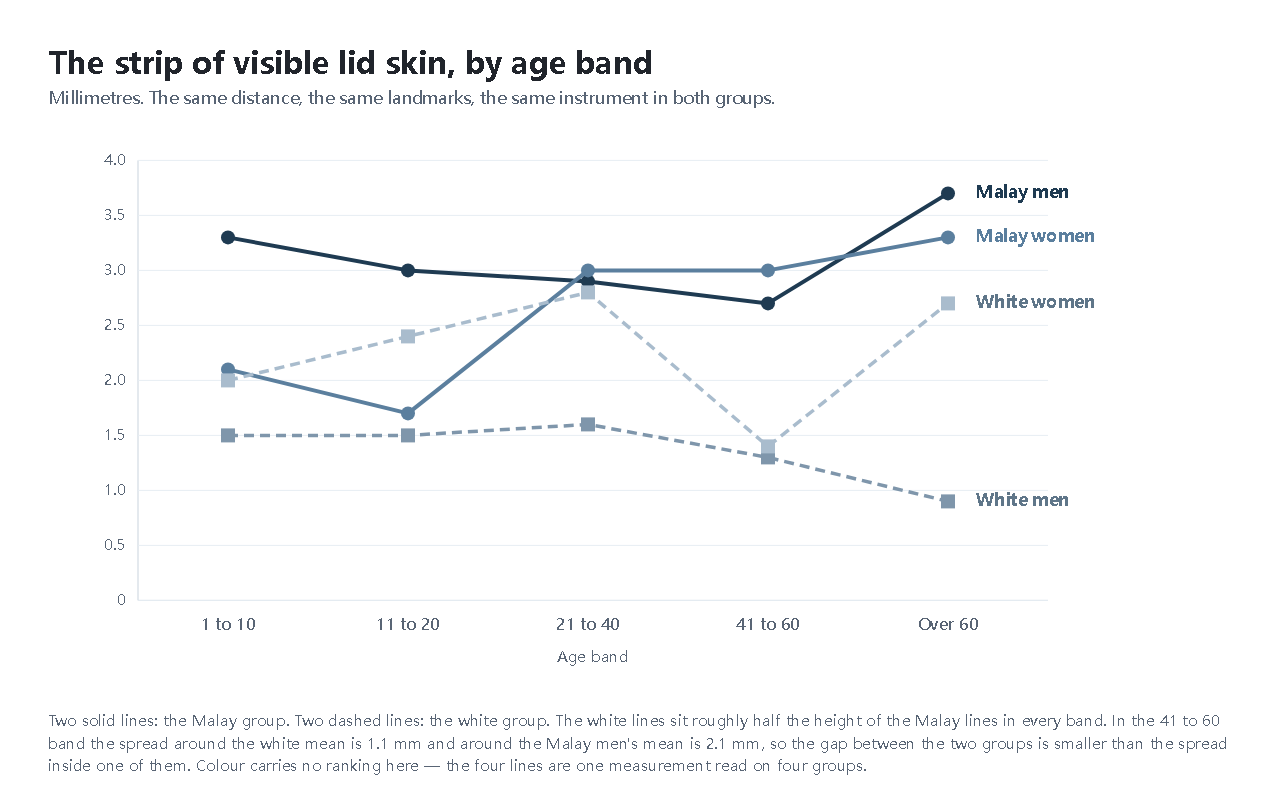
| Age band | White men | White women | Malay men | Malay women |
|---|---|---|---|---|
| 1 to 10 | 1.5 | 2.0 | 3.3 | 2.1 |
| 11 to 20 | 1.5 | 2.4 | 3.0 | 1.7 |
| 21 to 40 | 1.6 | 2.8 | 2.9 | 3.0 |
| 41 to 60 | 1.3 | 1.4 | 2.7 | 3.0 |
| Over 60 | 0.9 | 2.7 | 3.7 | 3.3 |
Read the 41 to 60 band across: 1.3 mm, 1.4 mm, 2.7 mm, 3.0 mm. The two white figures are half the two Malay figures, on the same measurement, in the same band. The four figures do not say which of those lids is the hooded one, because the word is being asked to do a job a population figure cannot do.
The direction of travel is not shared either. In the Malay set the male strip narrows as age rises — 3.3 mm, 3.0 mm, 2.9 mm, 2.7 mm — and then rises to 3.7 mm past 60, while the female strip widens from 1.7 mm to 3.3 mm over the same bands. An age band therefore points in opposite directions for the two sexes, and a page that says hooding increases with age is describing one of those columns and not the other.
The two heights that get quoted instead
When a number does appear on this subject it is usually one of the two heights above the strip, not the strip itself. Both are larger by a factor of several, so a reader comparing them with a strip figure is comparing different distances.
| Age band | White men | White women | Malay men | Malay women |
|---|---|---|---|---|
| 1 to 10 | 4.5 | 5.3 | 6.2 | 4.6 |
| 11 to 20 | 5.8 | 6.5 | 5.9 | 4.8 |
| 21 to 40 | 6.9 | 7.3 | 6.1 | 6.5 |
| 41 to 60 | 7.0 | 6.2 | 6.2 | 6.0 |
| Over 60 | 6.7 | 7.5 | 6.8 | 5.4 |
| Age band | White men | White women | Malay men | Malay women |
|---|---|---|---|---|
| 1 to 10 | 6.1 | 6.5 | 12.0 | 9.3 |
| 11 to 20 | 6.5 | 7.1 | 13.0 | 9.9 |
| 21 to 40 | 6.4 | 7.6 | 11.7 | 11.0 |
| 41 to 60 | 6.2 | 6.4 | 12.3 | 14.4 |
| Over 60 | 6.6 | 7.6 | 14.7 | 16.8 |
Put the three scales side by side and the size of the mismatch is plain. The strip runs 0.9 to 3.7 mm. The crease runs 4.5 to 7.5 mm. The brow runs 6.1 to 16.8 mm. Inside any one group and age band the brow sits between about two and a half and seven times the strip, and the crease between about one and a half and seven and a half times it. The brow is the figure most often quoted, because a tape measure reaches it without lifting anything. A reader who takes a brow figure and compares it with a strip figure has changed the distance without changing the label.
What the listed checks do with the strip
The checks that come up on this subject are not measuring the wrong lid. They are describing the right strip, in words, and stopping there.
| The listed check | What it reads |
|---|---|
| Skin from below the brow extends down and touches, or nearly touches, the lashes | The strip — as a reach, not a figure |
| Excess skin folds down from the brow bone and partially or entirely covers the lid | The strip — as a coverage word |
| A crease hidden behind a fold; the visible lid a thin sliver or nothing | The strip — as a sliver or nothing |
| Eyeshadow applied with the eye closed vanishes into the fold when the eye opens | The strip — as present or absent |
| The edge of the lid checked against the pupil, normally resting just below the top of the iris | Lid opening, which is a different distance |
| A tired or stressed look | Nothing measurable |
Four of the six describe the strip, and each of those four uses a word where a number exists — reaches, covers, sliver, vanishes — and they do not name the two points the strip is taken between. That is the gap: the strip is the quantity the word is about, and it is the quantity the checks leave as an adjective.
Where the spread eats the threshold
A threshold needs the spread around it to be smaller than the distance between the groups it separates. Here it is not.
| Group and band | Mean strip | Spread | Spread as a share of the mean |
|---|---|---|---|
| Malay men, 41 to 60 | 2.7 mm | 2.1 mm | 78 per cent |
| Malay men, over 60 | 3.7 mm | 2.1 mm | 57 per cent |
| Malay women, 41 to 60 | 3.0 mm | 1.5 mm | 50 per cent |
| White adults, 41 to 60 | 1.4 mm | 1.1 mm | 79 per cent |
Take the last row first. A mean of 1.4 mm with a spread of 1.1 mm puts a large share of the group below 1.4 mm and a substantial share close to zero. The low end of that spread is what the word hooded is pointing at, and it sits inside the group, not at the edge of it. Now take the first row: 2.7 mm with a spread of 2.1 mm covers from about half a millimetre upward. A cut-off placed anywhere in either row falls inside the spread of the other. That is why a fixed threshold cannot hold: the quantity it would have to separate on moves further between groups than the threshold is wide.
Set the two adult figures against each other and the arithmetic is blunt. The 41 to 60 band reads 1.3 mm in white men and 2.7 mm in Malay men, a gap of 1.4 mm. The spread in the white set is 1.1 mm and the spread in the Malay set is 2.1 mm. The gap between the groups is smaller than the spread of one of them. No number can be both the top of the normal range and the start of a condition when the range is that wide.
When to stop
- Stop when a strip figure arrives without its two points. The strip runs from the lash line to the fold, or to the crease if there is no fold. A number that names neither edge cannot be repeated on your own face, because the upper edge is exactly what a hooded lid changes.
- Stop when a crease figure is used as a strip figure. They are read in different positions of the eye, and on a covered crease the crease number can only be taken with the fold lifted clear. The two are not interchangeable even on the same eye.
- Stop when a brow figure is compared with a strip figure. Inside one group and age band the brow runs up to seven times the strip, and the crease almost as far. Two numbers that far apart are two different measurements, whatever the sentence around them says.
- Stop when one band is quoted for everyone. The same band reads 1.3 mm in one group and 2.7 mm in another, and the gap between them is smaller than the spread inside either.
- Stop when a word is used where the strip is meant. Reaches, covers, sliver, vanishes — four descriptions of one measurable strip. If the description is the whole claim, there is nothing left to check.
The strip, the crease and the brow, by age band, sex and population, as a CSV.
The strip on one card
Questions
What are hooded eyes?
A hooded lid is a lid where skin from the brow area has come down over the upper lid, so that the strip of visible lid skin between the lash line and the fold is short or absent. The strip is the quantity the word is about. It is measured from the lash line to the fold, or to the crease if no fold is present, with the eye open and looking straight ahead.
How much visible lid counts as hooded?
There is no figure that separates hooded from not hooded, and the readings on this page show why. The same adult band reads 1.3 mm in one group and 2.7 mm in another, and the spread inside each group is about four fifths of its own mean. Any cut-off you pick falls inside the spread of a group you did not measure.
Are hooded eyes the same as deep-set eyes?
No. Deep-set describes where the eyeball sits in the socket, read from the outer rim of the socket to the front of the cornea. Hooded describes how much lid skin is left visible below the fold. Both shorten the visible lid, which is why the two words get used together, but they are read on different distances and a face can have either one without the other. The deep-set page takes the socket distance and the checks that read the brow instead.
Why does the same lid get called hooded by one person and not another?
Because the strip is read with the eye at rest, and the look is read from a photograph or a mirror, where the brow can be held higher or lower than it sits at rest. Raising the brow moves the fold and opens up apparent lid space without changing the strip. Two people reading two photographs of the same face can therefore disagree, and both can be describing what they see.
Do the two heights above the lid matter?
They matter, but they are not the strip. The crease sits 4.5 to 7.5 mm above the lash line and the brow 6.1 to 16.8 mm above it, against a strip of 0.9 to 3.7 mm. Changing where the crease sits, or how low the brow rests, changes how much the fold covers — which is why brow position comes up so often on this subject. It does not change the distance the word is about.
Related guides
- Eye Shape Chart — the seven eye readings in millimetres, and what that chart says it does not record.
- Deep-Set Eyes — the socket distance, and the brow-based checks that do not measure it.
- Eyebrow Shape Chart — the brow read on its own, without the lid underneath it.
- Face Symmetry Test — the same face read twice, and what a small head turn does to the number.
- Face Shape Chart — the thirds of the face, and how to check them at home with a soft tape.
- Golden Ratio Face — the classical proportions, written out in millimetres on one face.