FACE FORM FINDER · 8 OCTOBER 2026
Pupillary Distance
Every figure in the two tables below is worked out from that one rule, and the arithmetic is left visible so it can be repeated. What follows is not another way to measure your pupillary distance; it is what a wrong one costs once the lens is made.
Why the offset becomes a prism
A lens is ground with an optical centre, the point where light passes through without bending. For the lens to correct your vision, that point has to sit over your pupil, and your pupillary distance is the number that places it there.
When the number is wrong, the optical centre lands off the pupil by exactly the error. A lens read away from its optical centre bends light the way a prism does, and the size of that bend is the offset multiplied by the power of the lens.
The error, at each lens power
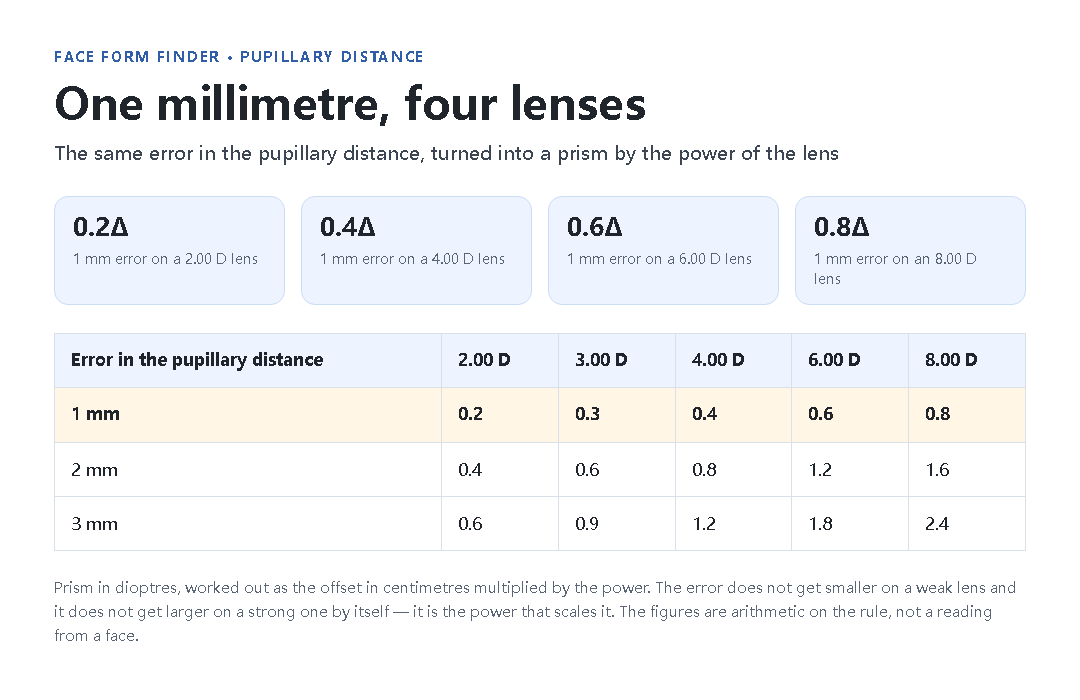
Read down the left column for the error and across the top for the power. Each cell is the prism that error produces at that power, in prism dioptres.
| Error in the pupillary distance | 2.00 D | 3.00 D | 4.00 D | 6.00 D | 8.00 D |
|---|---|---|---|---|---|
| 1 mm | 0.2 | 0.3 | 0.4 | 0.6 | 0.8 |
| 2 mm | 0.4 | 0.6 | 0.8 | 1.2 | 1.6 |
| 3 mm | 0.6 | 0.9 | 1.2 | 1.8 | 2.4 |
The whole table was worked out on 2026-10-08: the error in centimetres multiplied by the power in dioptres, so 1 mm at 8.00 D is 0.1 against 8, which is 0.8.
The error that reaches half a prism dioptre
Turned around, the same rule gives the error that produces a given prism. Half a prism dioptre arrives at 2.5 mm on a 2.00 D lens, and at 0.6 mm on an 8.00 D lens. The stronger the lens, the smaller the error that gets there.
| Prism | 2.00 D | 3.00 D | 4.00 D | 6.00 D | 8.00 D |
|---|---|---|---|---|---|
| 0.5 prism dioptres | 2.5 mm | 1.7 mm | 1.25 mm | 0.8 mm | 0.6 mm |
| 1 prism dioptre | 5.0 mm | 3.3 mm | 2.5 mm | 1.7 mm | 1.25 mm |
This table was worked out on 2026-10-08 by dividing ten times the prism by the power, which is the same rule read backwards.
The line one page on the first page draws
One page on the first page for this term gives the line directly. It puts the power at above 3.00 D for the point where a one millimetre error can produce a prism worth noticing, and it lists one millimetre as the error at which symptoms can begin.
Read through the rule above, one millimetre at 3.00 D is 0.3 prism dioptres. So 0.3 is the size of the thing that page is describing, and every other cell in the two tables is that same number scaled by the error and the power.
Two numbers, two offsets
A single pupillary distance is one number across the pair, so a single error moves both optical centres by the same amount and the two lenses carry the same prism.
A dual pupillary distance is two numbers, one for each side. An error in a dual reading can differ between the two sides, and when it does, the two lenses carry prisms of different sizes. The eye behind the larger one does the extra work, which is why an uneven pair is the case worth checking first.
The distance figure on a near pair
One page on the first page gives the rule for near glasses: take the distance figure and subtract 3 mm. A single pupillary distance spans the pair, so 3 mm across the two is 1.5 mm at each lens.
Ordered to the distance figure instead, a near pair carries that 1.5 mm as an offset at each lens, and through the same rule it becomes 0.3 prism dioptres at 2.00 D and 0.6 at 4.00 D. This paragraph is a model of the arithmetic, not a reading from anyone's glasses, and it assumes the two sides take the same share of the change.
What the error feels like
The pages on the first page list the symptoms of a pair made to the wrong figure: eye strain, headaches above the eyes or across the forehead, blur or double vision, and a sense that something is off without a clear reason. Those symptoms are the prism above, felt rather than measured, and they are the reason the number is worth getting right rather than merely getting.
Both tables, the rule behind them, the two offsets a dual reading can carry, and the near-pair model, as a CSV.
One millimetre, four lenses
Questions
What is pupillary distance?
Pupillary distance is the gap between the centres of your two pupils, in millimetres. It is the number that places the optical centre of each lens over the pupil, and some pages call the same measurement interpupillary distance. The two names describe one distance.
Does a small error in pupillary distance matter?
It matters in proportion to the power of the lens. One millimetre is 0.2 prism dioptres at 2.00 D and 0.8 at 8.00 D, so the same error is four times the size on the stronger lens. That four-times figure is worked out from the rule above rather than measured on a face. On a weak pair the same millimetre is close to nothing.
What happens if the pupillary distance is wrong on my glasses?
The optical centre of each lens lands off the pupil by the error, and the lens then bends light as a prism. The pages on the first page describe the result as eye strain, headaches, blur or double vision, and a vague sense of discomfort that is hard to place.
Is a single or a dual pupillary distance better?
They record different things. A single figure spans the pair and gives one offset for both lenses; a dual figure records each side, so an error can differ between the two. A dual reading carries more information, and it is also the reading that can go uneven.
Can I use my distance pupillary distance for reading glasses?
The rule one page on the first page gives is to subtract 3 mm for a near pair. Used as printed for near work, the distance figure is off by that much across the pair, which is 1.5 mm at each lens and 0.3 prism dioptres at 2.00 D. It is a small amount on a weak reading lens and a larger one as the power climbs.
Related guides
- Eye Shape Chart — the pupil-centre distance as one of seven readings of the eye opening.
- Glasses for Round Face — the frame measurements that decide where the lens centre sits on the face.
- Face Shape Chart — the readings that build a face shape from the brow ridge down.
- Midface Ratio — what happens to a reading when the same face is measured to two different end points.
- Face Symmetry Test — the left-right reading of the same photograph.
- Philtrum Length — another short distance on the same face, and the end point that decides it.