FACE FORM FINDER · 8 OCTOBER 2026
Philtrum Length
The figures, side by side
| Page | The figure it prints | The span it runs between |
|---|---|---|
| Cadogan Clinic | long above 11–13 mm (women), 13–15 mm (men) | the base of the nose to the top of the upper lip |
| wikiHow | long above 12 mm (women), 15 mm (men) | the base of the nose to the top of the upper lip |
| Orofacial Myology | 15 mm, the figure the clinic looks for | not printed |
| Onlif Clinic | a reference range of 11–18 mm (women), 13–22 mm (men) | subnasale to labrale superius, the red border of the upper lip |
| QOVES | an average of 20 ± 2 mm (women), 22 ± 2 mm (men) | the mid-philtral height |
The five figures above were read from the front page of results for this term on 2026-10-08.
Three cut-offs on one line
The first three rows measure the same span: from the base of the nose down to the top of the upper lip. On that one line the cut-offs are 11 to 13 mm, 12 mm and 15 mm. They do not nest inside one another and they do not agree. A philtrum of 14 mm is long by two of the three and ordinary by the third, and nothing about the face decides which answer you get — only which page you opened.
The two rows under them print a different kind of figure. One gives a range rather than a cut-off; the other gives an average. Neither is a line a single reading can be held against, because a range says where a group sits and an average says where its middle is. Neither one says what is long.
Where the fourth figure comes from
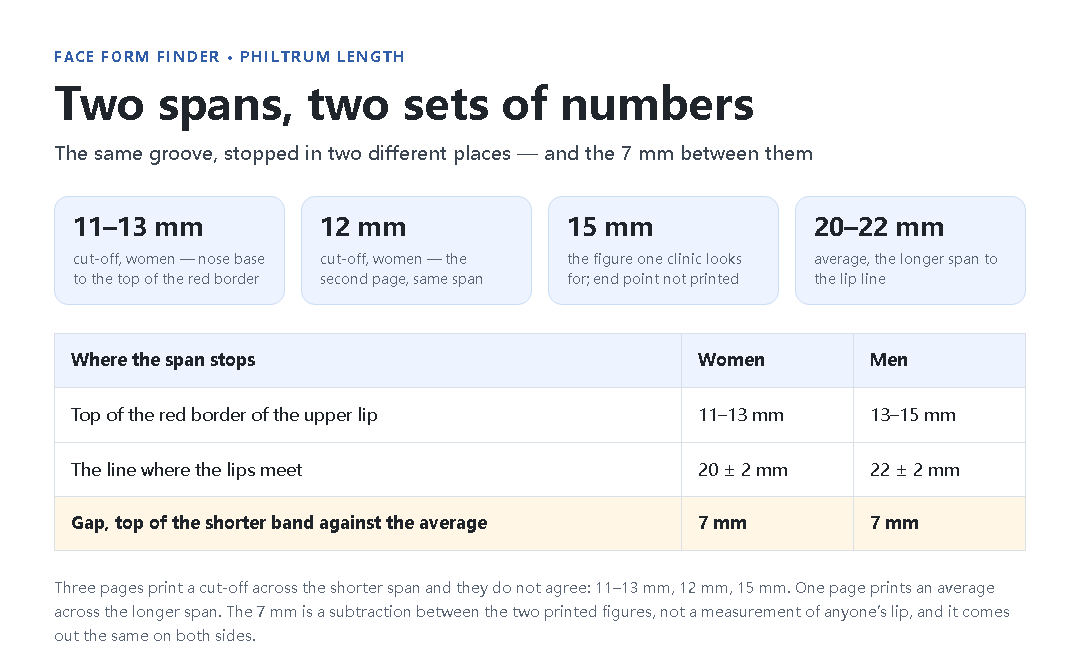
The last row is the odd one out, and the page gives its own reason: its reading runs 1 to 3 mm short of the commissure height — the level of the corners of the mouth. That is a longer span than the one the three cut-offs are measured across. Line the two sets up and the difference is the same on both sides.
| The figure | Women | Men |
|---|---|---|
| Cut-off, base of the nose to the top of the upper lip | 11–13 mm | 13–15 mm |
| Average, mid-philtral height | 20 ± 2 mm | 22 ± 2 mm |
| Gap, top of the shorter band against the average | 7 mm | 7 mm |
The two sets above were read on 2026-10-08. The 7 mm is worked out rather than transcribed: it is the average minus the top of the shorter band, in each column.
The gap is 7 mm on both sides. It is a subtraction between two printed figures, not a measurement of anyone’s lip, and it is not a difference between two groups of faces. It is the width of the band the shorter span leaves out — the strip between the top of the red border and the line where the lips meet. Two pages can measure the same groove, print numbers 7 mm apart, and both be describing the same face.
The chin ratio, written two ways
Both pages that print a cut-off also print a ratio against the chin, and here they split again. One gives the chin-to-philtrum ratio in three bands — 2:1 as the ideal, 1:1 as long, 3:1 as short. The other gives one band: a philtrum longer than half the chin. Written as fractions, the ideal is the same on both pages — a chin twice the philtrum. The cut-off for long is not.
| Page | Ideal | Long | Short |
|---|---|---|---|
| Cadogan Clinic | 2:1 | 1:1 | 3:1 |
| wikiHow | about half the chin (2:1) | more than half the chin | less than half the chin |
Both columns are transcribed as each page prints them, and both were read on 2026-10-08; the fractions are not worked out here.
Read as fractions, “1:1” and “more than half the chin” are not the same line. A chin equal to the philtrum is one way of calling it long; a philtrum that has just crossed half the chin is another. Take a hypothetical face with a chin one and a half times its philtrum: it is long by one page and unnamed by the other, which prints nothing between its 2:1 and its 1:1.
What the number cannot do
- It does not name its own end point. Two of the pages that print a cut-off never say where the span ends. “Long above 12 mm” is only checkable if you know whether the 12 mm runs to the top of the red border or to the line where the lips meet.
- It does not say why. The same length can come from a shorter upper lip, a lower nose base, or both at once, and the number is identical either way.
- It does not describe a person. It describes one measurement of one face, taken once.
- It does not travel between pages. A figure is comparable only against a figure measured across the same span, in the same unit, with the same end point.
When to stop
- Stop when the page never prints its end point. A length with no second landmark attached cannot be held against any other number.
- Stop when two pages give the same word and different spans. “Long above 15 mm” and “an average of 20 mm” are not two opinions about one measurement.
- Stop when the unit changes. Inches, millimetres and fractions of the chin are three different scales, and a figure in one cannot be read against a figure in another.
- Stop at a single figure with no line under it. If a page hands you a number and no span, there is nothing left to check.
Every figure on this page, the span each one is measured across, the gap between the two sets, and the two ways the chin ratio is written, as a CSV.
Two spans, two sets of numbers
Questions
What is a normal philtrum length?
The pages on the first page do not settle on one answer. Two of them put the ordinary band at roughly 11 to 15 mm, one puts the figure it looks for at 15 mm, and one prints an average of 20 mm for women and 22 mm for men. Those last two figures are measured across a longer span, so they are not a higher opinion about the same distance. Ask which span a page is using before you compare your own reading with it.
Is a 15 mm philtrum long?
It depends on the span. Measured from the base of the nose to the top of the upper lip, 15 mm sits at the top of one page’s cut-off for men and above another page’s cut-off for women. Measured to the line where the lips meet, 15 mm is well under the 20 to 22 mm average that one page prints. The number is the same; the two spans are not.
Why do two pages give different philtrum lengths?
Because they stop the measurement in different places. One stops at the top of the red border of the upper lip; another stops at the level of the corners of the mouth, which is a longer span. The two printed sets sit 7 mm apart, and that 7 mm is the difference between the two end points rather than a disagreement about faces.
Can I measure my philtrum at home?
Yes, if you decide where to stop before you start. Take the base of the nose as the top landmark, then choose one lower landmark — either the top of the red border of the upper lip or the line where the lips meet — and write it down with the number. A reading with no lower landmark recorded cannot be compared with any of the figures above.
Does philtrum length change with age?
The pages on the first page treat this as a question about the surrounding landmarks rather than about the groove itself. The upper jaw finishes most of its growth early while the lower jaw keeps going, and the lips change with age as well. Any change you read is therefore a change in the span between two landmarks, not a change in the groove on its own.
Related guides
- Midface Ratio — what happens to a reading when the same face is measured to two different end points.
- Face Shape Chart — the thirds of the face, and how to check them at home with a soft tape.
- Mustache Styles — the upper-lip half of the beard, read against the space above the lip.
- Lip Shape Chart — the upper and lower lip recorded as separate observations.
- Chin Shapes — the chin as a measured span, before it is used as a ratio.
- Jawline Shape — the three jaw readings, and how far the sample spread runs.