FACE FORM FINDER · 2 OCTOBER 2026
Mustache Styles
The five measurements the lip gives you
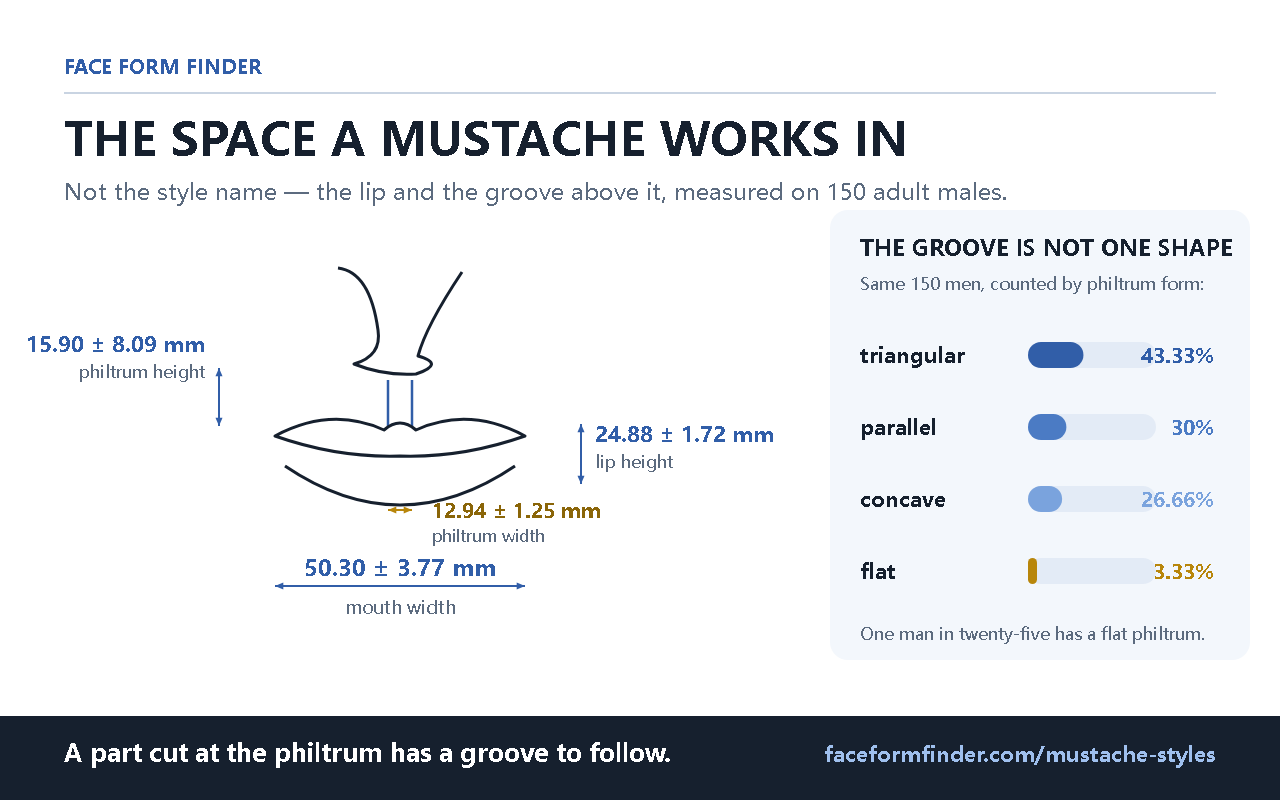
Every style on this page sits on the same five lengths. They were taken on 300 medical students in eastern Nepal, 19 to 24 years old, 150 of them male, with a digital vernier caliper and the lips closed. The middle column is that group; the fourth column is what other measured populations put beside it.
| What is measured | What it runs between | Adult males (n = 150) | Other populations state | Which style decision leans on it |
|---|---|---|---|---|
| Mouth width | corner of the mouth to corner of the mouth | 50.30 ± 3.77 mm | 47.17 (North Indian, n = 300); 47.3 (Malaysian Indian, n = 50); 48.8 (Malay, n = 50); 53.5 (Western Indian); 54.1 (White American, n = 50) | how far a style can run before it passes the mouth corner — the Western, the Horseshoe and the Fu Manchu all extend past it |
| Lip height | top edge of the upper lip to the bottom edge of the lower lip | 24.88 ± 1.72 mm | no figure in the comparison set | how much vertical band a Chevron or a Walrus has to cover before it reads full |
| Philtrum height | base of the nose to the top of the upper lip | 15.90 ± 8.09 mm | 14.19 (Indonesian); 14.30 (Central Nepal, n = 400); 10.40 (Malay, n = 50); 17.93 (Mashad) | how much bare skin sits between the nose and the top of the mustache |
| Philtrum width | the groove’s own width | 12.94 ± 1.25 mm | 13.86 (Indonesian); 11.85 (Central Nepal, n = 400); 12.71 (Malay, n = 50); 14.98 (Mashad) | where a centre part can be cut — the English, the Pencil and the Dali all split here |
| Lip area | the red of both lips together | 58.29 ± 1.06 mm² | 59.53 (Mashad) | how much lip a Pencil leaves bare, and how much a Chevron has to cover |
Read the spread before the average. The philtrum height carries the widest spread in the set — 15.90 mm with a standard deviation of 8.09, so the average is a weak description of any one face. Mouth width is the tightest, and it still moves 7 mm across the six populations listed. A style described only by a name tells you nothing about which of those lengths it was drawn against.
The centre of the mustache is a separate decision
The philtrum is not one shape. In the same 150 adult males it divided like this: triangular 43.33%, parallel 30%, concave 26.66%, flat 3.33%. Those are counts of a groove, not of a style, but the groove is exactly where two of the most-named techniques are applied.
The guides that describe the English and the Pencil both tell you to cut a hard part at the philtrum — the beardbrand guide calls it “a hard line at the philtrum (the indent above your upper lip)”, and the cremo write-up describes the English as “divided in the center, usually with a hard part at the philtrum”. Neither says what that line is being cut into. The measurement does: the groove averages 12.94 mm across, and one man in twenty-five has a flat one. A part cut into a flat philtrum has almost no groove to follow, while a triangular philtrum — the most common shape in this group at 43.33% — already carries a V that the part can run along.
This paragraph is this page’s reading, not a measured result. The groove counts and the millimetres are measured; the sentence linking them to how a centre part reads is an inference from them, and it is written here as one. No measured result says a part looks better on one philtrum shape than another.
What the style galleries already give you
The part that is already answered is the list, and it is answered thoroughly. The aggregation layer above the results maps the named styles to face shapes in one pass: Chevron to square faces and strong features, Handlebar to oblong or square faces, Walrus to oval or triangular faces, Pencil to round faces, Horseshoe to square jawlines, Beardstache to short stubble. The cremo write-up carries the same idea at length — softer, smaller shapes to contrast a sharp jawline — and the beardbrand guide runs every style through its own growing and grooming instructions.
The growth clock is already given too. The GQ guide puts the Classic at about a month, the Pencil at as little as two weeks, and the Half Measure at at least a month, with the stubble backing cut to two or three millimetres. So the missing part is not the list, the face-shape map, or the timeline. It is the measurement the whole list sits on.
Each style, read against the measurement it leans on
The face-shape column below is the galleries’ mapping, carried over unchanged. The measurement column is this page’s, and it names the one length from the table above that the style is built on.
| Style | What it does with the lip space | The measurement it leans on | Face shape the galleries give | Tool |
|---|---|---|---|---|
| Chevron | covers the whole upper lip, with the edges angled down | lip height 24.88 mm — it is the style that has to cover the full band | square faces, strong features | comb and trimmer |
| Pencil | a thin strip along the top of the lip, clear of the red | philtrum width 12.94 mm — the strip is cut inside the groove’s width | round faces | razor and comb |
| English | split at the centre and pushed out horizontally | philtrum width 12.94 mm — the part is cut in the groove | not mapped by the galleries | comb and wax |
| Handlebar | runs to the mouth corners, then curls upward | mouth width 50.30 mm — the ends start at the corner and travel past it | oblong or square faces | wax and comb |
| Walrus | hangs over the top lip | lip height 24.88 mm — it covers the band and then drops past it | oval or triangular faces | comb and scissors |
| Horseshoe | drops from the mouth corners down to the jaw | mouth width 50.30 mm — the vertical arms hang from the corners | square jawlines | trimmer |
| Western | carried past the mouth corners, without the curl | mouth width 50.30 mm — it is the same corner as the Handlebar, held flat | not mapped by the galleries | comb and scissors |
| Beardstache | a full mustache sitting on short stubble | lip height 24.88 mm, plus stubble cut to 2–3 mm | not mapped by the galleries | trimmer and clipper |
The measurement column is not a fit rule. It says which length the style was drawn against, not which length your face has. The face-shape column is what the galleries already tell you, and the two are answering different questions.
The 54-second version
If the player does not load, watch it on YouTube: Mustache Styles: The Space Above the Lip, Measured.
Questions
What is the most attractive mustache style?
No measured answer is given here, because none of the pages read for this term carries one. There is no tally, rating or survey behind “most attractive” in the results, so any single style named as the winner would be an invented one. The decidable part is the one above: which styles are built on a length you can actually measure on your own lip.
Do Amish men shave?
This one is outside the page. It asks about a community’s practice rather than about a style, and none of the pages read for this term answers it. Leaving it out is deliberate: a sentence about a group’s custom is not something the measurements on this page can carry.
What is the current mustache trend?
No dated tally is given here either. The galleries name styles as current without giving counts, search figures or dates behind the claim, so the only honest reading is that “current” on those pages means the page was written recently. If a trend claim comes with no number, treat it as a description of the writer’s week.
Are mustaches back in style in 2026?
One of the pages read for this term opens with exactly that claim — “Mustaches are back in style!” — and it is reported here as it stands, with no figure behind it. What the same page does supply is the part you can use: a style-by-style growing and grooming walkthrough. Take that, and treat the revival line as the page’s own framing.
Related guides
- Beard styles for face shapes — the full-beard version of the same face-shape question.
- Beard length chart — what each guard number leaves on the skin, in millimetres and inches.
- How to trim beard neckline — the neck edge, with the measured distances behind the two-finger rule.
- Face shape chart — confirm the outline before the style conversation.
- Beard styles for a round face — the round-face column, taken on its own.
The five lip measurements and the eight styles, each with the value and the address behind it, as a CSV.