Face Form Finder
How to Trim a Beard Neckline: The Millimetres Behind the Two-Finger Rule
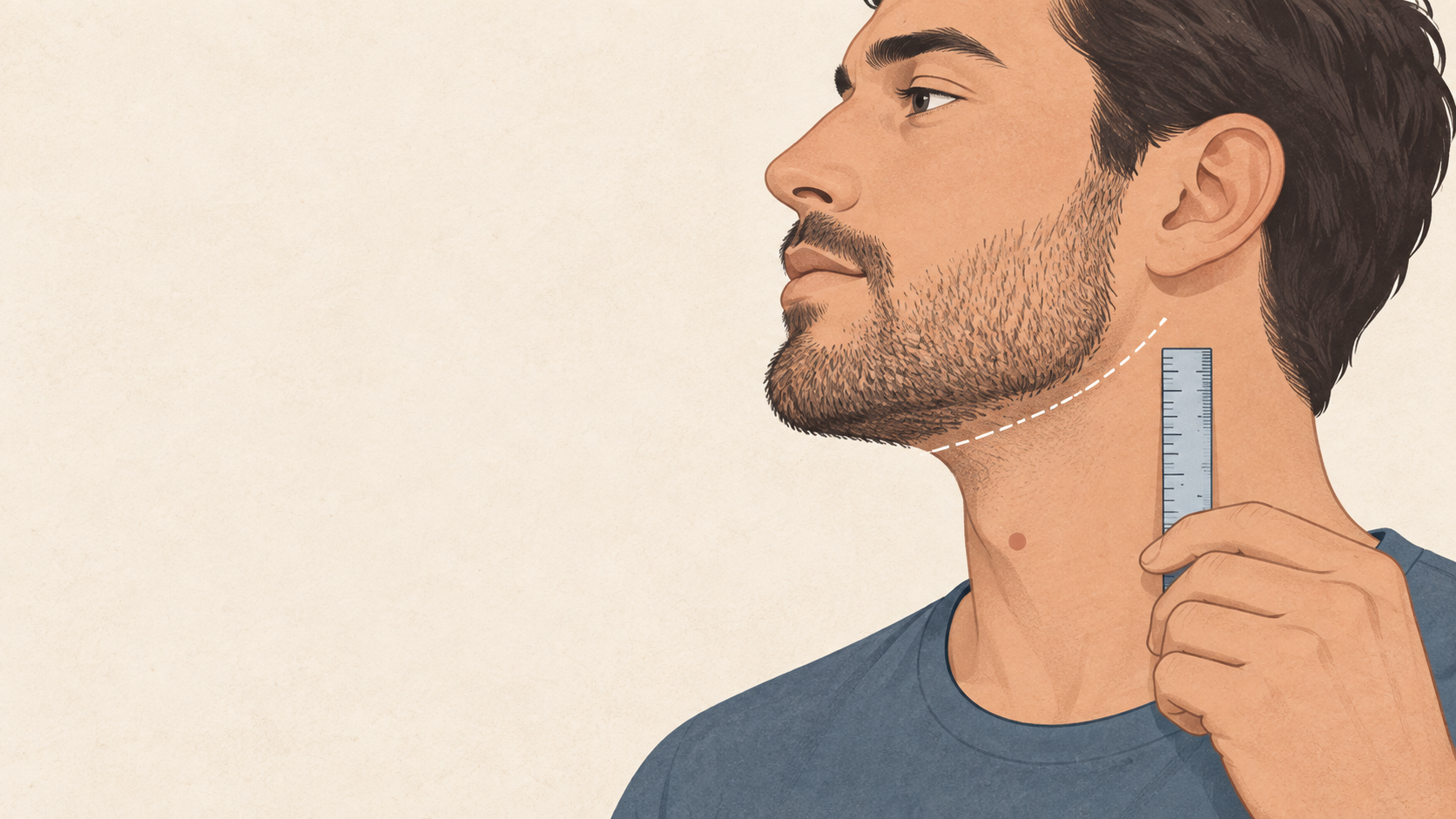
Every neckline guide lands on the same instruction: find your Adam's apple, then set the line two fingers above it. Two of them put a number on it — about 1.5 inches. None of them say how far apart the two landmarks actually sit. Below are the measured distances from the underside of the chin to the thyroid notch and to the sternal notch, taken on 300 and 610 adults.
| What is measured | Runs between | All (n = 300) | Group A (n = 254) | Group B (n = 46) |
|---|---|---|---|---|
| Thyromental distance | underside of the chin to the notch at the top of the thyroid cartilage | 6.7 ± 1.0 cm | 6.8 ± 1.0 cm | 6.1 ± 0.9 cm |
| Thyromental height | the same notch measured as a height above the front of the neck | 4.8 ± 0.9 cm | 4.9 ± 0.9 cm | 4.4 ± 0.9 cm |
| Sternomental distance | underside of the chin to the notch at the top of the breastbone | 16.0 ± 2.0 cm | 16.2 ± 1.9 cm | 15.0 ± 2.3 cm |
| Mandibular length | the jaw bone along its lower edge | 9.2 ± 0.7 cm | 9.2 ± 0.7 cm | 9.2 ± 0.7 cm |
The 300 adults were patients at one hospital in India, 182 men and 118 women, measured with a rigid ruler and rounded to the nearest half centimetre. Groups A and B are the same 300 people split by how the larynx looked when it was viewed directly: 254 fell in the easier group and 46 in the harder one. That split is not a beard matter, but it is the only way the numbers were set out, and it shows how much one neck can differ from another: 6.7 cm on average, with a spread of a full centimetre either side, and 0.7 cm between the two groups.
The three landmarks, and where to find them
Three points carry every number on this page, and all three can be felt with a fingertip.
- The underside of the chin — the lowest point of the chin in profile, where the chin pad stops and the neck begins. It is the top end of three of the four measurements above.
- The thyroid notch — the dip you can feel at the top of the thyroid cartilage, the plate that projects as the Adam's apple. It is the bottom end of the thyromental distance, which is the distance the two-finger rule is measured up from.
- The sternal notch — the dip at the top of the breastbone, between the two collar bones. It is the bottom end of the sternomental distance, which is the longest run on the neck and the one most affected by how you hold your head.
The thyromental distance describes the space between the underside of the chin and the landmark the rule tells you to work up from. A neckline set two fingers above the thyroid notch sits somewhere inside that run. Using that distance to choose a beard edge is a grooming inference, not a result validated by these clinical measurements; it only makes the reference point explicit.
What the two-finger rule is really saying
Two of the guides in circulation put a figure on the rule: two fingers above the Adam's apple, which they give as about 1.5 inches. One inch is 25.4 millimetres, so 1.5 inches is 38.1 millimetres.
Set that against the first row of the table. The average thyromental distance in the 300 adults is 6.7 centimetres, which is 67 millimetres. Subtract the 38.1 millimetres the rule puts between the notch and the line, and the line lands about 28.9 millimetres below the underside of the chin — 67 − 38.1 = 28.9. That is under three centimetres, on a neck where the run itself averages 6.7 centimetres and ranges across a full centimetre either side of it.
Two things follow. The first is that the rule is a fraction of the run, not a fixed height: on a neck with a short thyromental distance, 38.1 millimetres up from the notch is a larger share of the way to the chin than it is on a neck with a long one. The second is that two fingers are not a unit. The rule works because a finger is being used as a stand-in for a distance nobody wrote down.
Head position moves the line
The sternomental distance was measured twice on 610 adults in India: once with the head in a neutral position and once with the head extended backwards. The difference between the two readings is the sternomental displacement, and it is large enough to matter.
| Group | Sternomental distance | Sternomental displacement |
|---|---|---|
| Men | 16.28 ± 2.22 cm | 6.24 ± 1.69 cm |
| Women | 14.74 ± 1.91 cm | 5.66 ± 1.49 cm |
| Children 7–9 years, reference threshold | ≤ 10 cm | — |
| Children 10 years and over | adult thresholds apply | — |
The two adult rows were measured on 610 patients with the same rigid ruler and the same half-centimetre rounding, and the gap between them runs in the same direction as the gap in the neck itself: men 1.54 cm longer at rest, and 0.58 cm more when the head goes back. The two child rows are not averages. They are the thresholds used to decide whether a measurement counts as short, which is why they read as limits rather than means, and why the 7–9 year group sits at 10 cm against an adult group nearer 16.
The displacement figure is the practical one. Extending the head backwards lengthens the run between chin and breastbone by more than six centimetres on the men and by more than five and a half on the women. Anything you mark on the neck while looking up at a mirror is being marked on a neck that is not in the position you will be seen in.
How to use the landmarks as a reference
These three readings can make the two-finger reference more explicit on your own neck. They do not prescribe a medically or clinically correct beard-line placement; use a ruler and a straight-on mirror only to compare a proposed grooming mark before shaving.
- Set your head level first. Look straight at the mirror, chin neither tucked nor lifted. The numbers above were taken with the head neutral, and the displacement row shows how far the reading moves once it is not.
- Find the notch before you find the line. Run a fingertip down the front of the neck from the chin until you feel the first hard plate, then the dip at its top. That dip is the thyroid notch, and it is the point the two-finger rule measures up from.
- Measure the run, then compare a proposed mark. Put the ruler at the underside of the chin and read down to the notch. Compare that with 6.7 cm. If your run is shorter than the average, a mark 38.1 millimetres above the notch is a larger share of the way up; if it is longer, the same reference leaves more neck below it than it does on the average neck.
None of the three readings is a beard measurement. They are neck measurements. Applying them to a beard line is an optional grooming inference, which is why the guides that skip them end up describing the line in fingers.
Beard neckline too high: stop raising it
If a neckline has already been cut too high, do not try to make the two sides look better by taking more hair from the top edge. That only moves the problem closer to the jaw. Stop cutting above the current line, keep the razor below it, and let the space between the current edge and the intended lower edge grow back before you redraw anything.
Use the thyroid notch and the underside of the chin again with your head level. Mark the proposed lower line without shaving it. If that mark falls below the current edge, the practical next move is to leave the current edge alone, not to carve a new hard line beside it. Once there is enough visible growth below it to choose an edge, make one light pass along the lower mark and compare both sides from the front and profile before removing more.
Short beard neckline: keep the line low and quiet
A short beard exposes the neckline more clearly, but it does not need a higher neckline. Start from the same landmarks: head level, thyroid notch found, and a proposed line compared against the chin-to-notch run. That comparison is a grooming choice, not a clinical placement rule. On a short beard, use a soft curve from one side toward the centre and check it at arm's length; a deep U or a sharp corner becomes obvious sooner because there is less length to soften it.
- Set the centre first. Mark the proposed lowest point above the thyroid notch before touching either side.
- Join it with short passes. Work from the centre outward with the trimmer flat to the skin. Stop after one pass on each side rather than chasing a perfectly dark outline.
- Check the connection. Look straight ahead, then turn to each profile. The line should leave a small, deliberate band of beard under the jaw rather than appearing to run up to the jawbone.
The guard number changes how much stubble remains, not where the neck landmark sits. For the length itself, use the beard length chart; use this page to decide where the lower edge belongs.
Where this leaves the trim
The neckline is the lower of the three lines that shape a beard, and it is the only one with a nearby palpable landmark. The other two — the cheek line and the upper edge beneath the jaw — run against soft tissue. A landmark can make a proposed neckline easier to repeat, but it does not establish where a beard edge should sit.
What the measurement buys you is a repeatable reference point. Two fingers change with the hand that holds them; a distance from the chin to the notch does not. The table above gives the range that distance fell in for 300 adults and the sex split for 610 more, not a validated beard-trimming target.
Related pages
- Beard length chart — what each guard number leaves on the skin, in millimetres and inches.
- Beard styles for face shapes — length bands for round, oval, square, heart and oblong faces.
- Jawline shape — the three measurements behind the labels, including the jaw corner angle.
- How long does it take to grow a beard — start the clock on the right day, then read it against the length you are after.