FACE FORM FINDER · 3 OCTOBER 2026
Receding Hairline Haircuts for Men
The number a receding hairline cannot change
Width is the number that gets skipped. A hairline that has moved back has not made the head narrower, and no cut makes it narrower either. Three forehead references are used on this page. The first is the height a cut works with; the other two are widths, and a receding hairline changes neither of them.
| Reference | Reading used here | Spread around it | What it changes |
|---|---|---|---|
| Hairline down to the brow | 61.4 mm | ±9.7 mm | A population reference mean for the height. Measure your own rather than adding to this one. |
| Forehead, widest part | 137.1 mm | ±18 mm | Nothing a cut does. It is the denominator the height is read against. |
| Width across the brow ridge | 133.9 mm | ±15.9 mm | A second width, taken at a different landmark. The two widths are not interchangeable, and no cut moves either one. |
The two widths sit 3.2 mm apart on the reference head. That is a difference between two reference means taken at different landmarks, not a measured gap on any one forehead, and no corner position, no difference between a centre and a side reading, and no coverage rule is derived from it here.
The number it does change
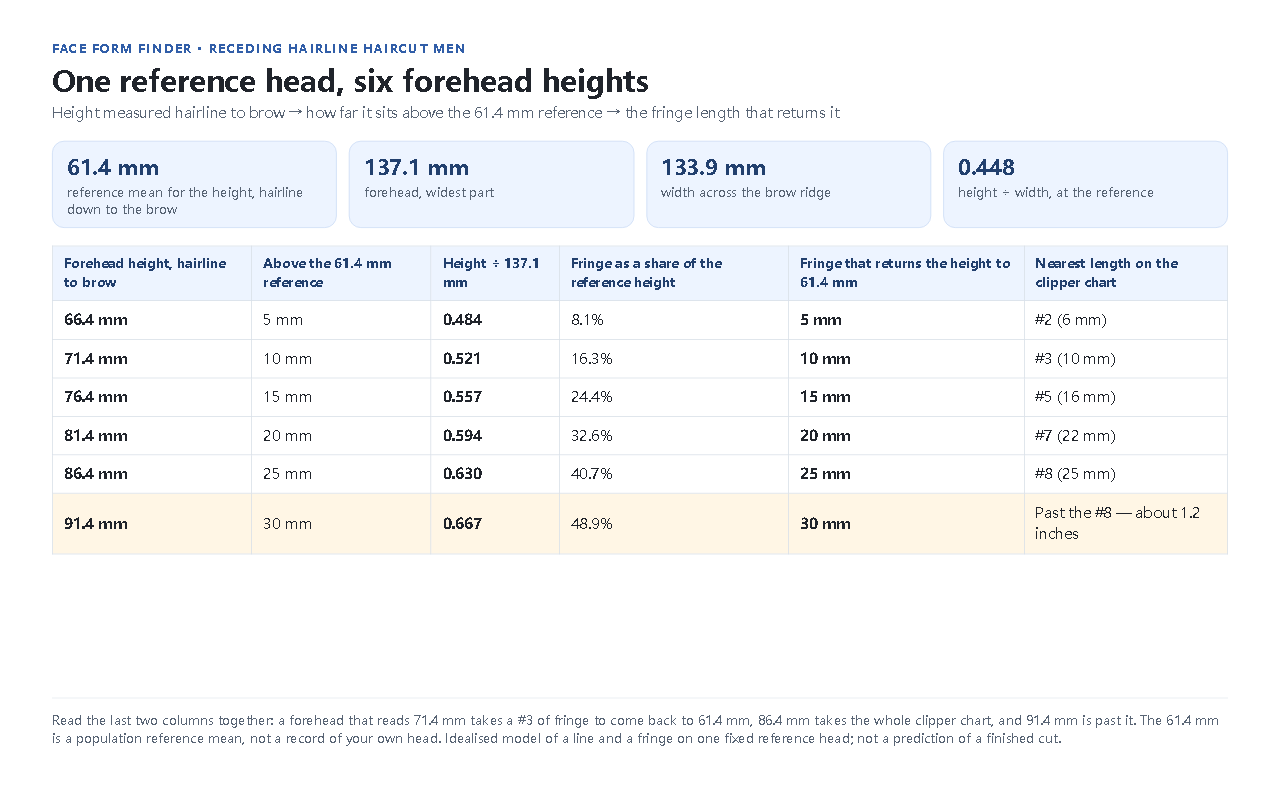
Divide the height you measured by the 137.1 mm. Nothing else moves. The rows run from 66.4 mm to 91.4 mm, which is 5 mm to 30 mm above the reference mean; the top row is already just under half the reference height.
| Forehead height, hairline to brow | Above the 61.4 mm reference | Height ÷ 137.1 mm | Fringe as a share of the reference height | Fringe that returns the height to 61.4 mm | Nearest length on the clipper chart |
|---|---|---|---|---|---|
| 66.4 mm | 5 mm | 0.484 | 8.1% | 5 mm | #2 (6 mm) |
| 71.4 mm | 10 mm | 0.521 | 16.3% | 10 mm | #3 (10 mm) |
| 76.4 mm | 15 mm | 0.557 | 24.4% | 15 mm | #5 (16 mm) |
| 81.4 mm | 20 mm | 0.594 | 32.6% | 20 mm | #7 (22 mm) |
| 86.4 mm | 25 mm | 0.630 | 40.7% | 25 mm | #8 (25 mm) |
| 91.4 mm | 30 mm | 0.667 | 48.9% | 30 mm | Past the #8 — about 1.2 inches |
Read the last two columns together, because they are the instruction. A forehead that reads 71.4 mm — 10 mm above the reference mean — takes a #3 of fringe to come back to 61.4 mm; 86.4 mm takes the whole clipper chart; 91.4 mm is past it, which is why the family list further down changes shape rather than getting longer.
Where each family lands
Style names are useful once they are reduced to the one thing this page measures: how many millimetres of hair the cut leaves hanging in front of the line. A family either carries a fringe or it does not, and that is the fork the recession cares about.
| Family | Kept at the front | Hangs in front of the line? | What it does to the bare band |
|---|---|---|---|
| Buzz cut | 13 mm, uniform | No | Leaves the full band bare and flattens the contrast instead |
| Crew cut | 19 mm, brushed up | No | Leaves the band bare; the height goes upward, not forward |
| Textured or French crop | 25 mm, forward | Yes | Holds the height at the 61.4 mm reference up to 25 mm of extra height |
| Side-swept fringe | 50.8 mm, forward | Yes | Holds it well past the top of the clipper chart |
| Forward comb-over | 50.8 mm, forward and down | Yes | Same cover as the side-swept, taken from the other part |
| Slicked back | 50.8 mm, backward | No | Adds length and still exposes the band — the only family here that does both |
That last row is the one worth stopping on. A slicked-back cut and a forward comb-over are the same 50.8 mm of hair on the same head, and they land on opposite sides of this table. The difference is 50.8 mm of cover, which on the reference head is more than the 30 mm the table above runs to.
Your numbers, in order
The first comes off a tape measure in a mirror. The second is a choice. Both go down in millimetres rather than in a style name.
- The height you have now. Put the tape at the centre of the hairline and read straight down to the brow — the highest point of the brow ridge, or the crease you can find by raising your eyebrows. That distance is the bare band, and it is a reading rather than an estimate.
- The height you want to read. Either the 61.4 mm reference mean, or your own earlier reading if you have one. A recession is the difference between the two, and it can only be read when a record of the earlier line exists — a photo, or a measurement taken before the line moved. Without one, 61.4 mm is a mean across a population and cannot stand in for your own past height.
- The fringe. The table above gives the length that takes the height back to the figure you chose, and the nearest guard on the same clipper chart. If you are not willing to keep that length, the buzz cut, the crew cut and the slicked back are the honest answers, and they are answers rather than compromises.
All three tables — the three forehead references, the six forehead heights with the fringe length each one needs, and the six families — with the millimetres, the readings and the arithmetic behind them, as a CSV.
The 77-second version
If the player does not load, watch it on YouTube: Receding Hairline Haircuts for Men: The Fringe Length That Holds the Height.
Questions
What haircut should I get if my hairline is receding?
Answer it in millimetres rather than in a name. Measure the height you have now, hairline to brow, and choose the height you want it to read — the 61.4 mm reference mean, or your own earlier reading if you have one. The gap between the two is the fringe length that closes it: a textured or French crop covers up to about 25 mm of it and a side-swept fringe past that. If you will not keep that length, a buzz cut or a crew cut stops pretending to cover it and removes the contrast instead.
Can hair grow back on a receding hairline?
Nothing on this page measures regrowth, and no cut changes it. What a cut changes is how much of the bare band sits in front of hair and how much sits in open air. That is a measurement, and it is the one this page runs. Whether the line itself moves back or forward again is a separate question with a separate answer.
At what age do men's hairlines recede?
The age is not an input to this arithmetic, and the tables do not use it. The height in millimetres is the input, whatever age it arrives at. Two men in the same decade can sit four rows apart on the table above, and the row — not the birthday — decides the fringe length.
Does a receding hairline make your face look longer?
It makes the forehead read taller, which is a narrower claim. On the reference head the height-to-width reading moves from 0.448 at the 61.4 mm reference to 0.630 at 86.4 mm and 0.667 at 91.4 mm. The width is untouched throughout, so what changes is the top band and the reading that includes it — not the length of the face itself, which is measured from the hairline down.
Related guides
- Hairline Shapes — the four contours and the three heights, before the cut is chosen.
- Short Hairstyles for Men — the guard ladder in millimetres that the fringe lengths here are mapped onto.
- Facial Ratios — where the height-and-width readings on this page are set out in full.
- Haircuts for Men — the family list, once the fringe length is decided.
- Haircut Number Chart — every guard number pinned to its millimetre value.
- Medium Length Hairstyles Men — the band above the crop, read by where the ends land.
- Face Shape Chart — the width and length readings that come before the cut.