FACE FORM FINDER · 2 OCTOBER 2026
Short Hairstyles for Men
Why a gallery cannot answer a fit question
The pages that rank for short hairstyles for men are galleries, and the counts are real. One walks through forty-two short cuts. One lists thirty-six. One goes twelve deep with a barber explaining the exact wording to use in the chair, and one collects forty-five low-maintenance options. Each is organised by how the cut looks.
Face shape is handled the same way on all of them — as an adjective. A cut is filed as best for square faces, or for round or square faces, or with a note that height on top suits a round face. An adjective can rule a cut out. It cannot compute anything, because nothing in it is a distance.
Read the same pages for measurements and the gap shows up plainly. Across the readable text of the top results, the word cheekbone does not appear. Neither does face length, face width, or a length-to-width reading. Not one of them converts a guard number into millimetres of hair, and not one states a facial distance in millimetres. The words ratio, proportion and thirds appear once between all of them. What is missing from these pages is not another style. It is the millimetre.
The first number: what the sides leave
A guard number is not an adjective for short. It is a length, and it is stated as one. The guard chart on this site pins each number to a figure — a #0 at about 1.5 mm, a #2 at about 6 mm, a #4 at about 13 mm, a #8 at about 25 mm.
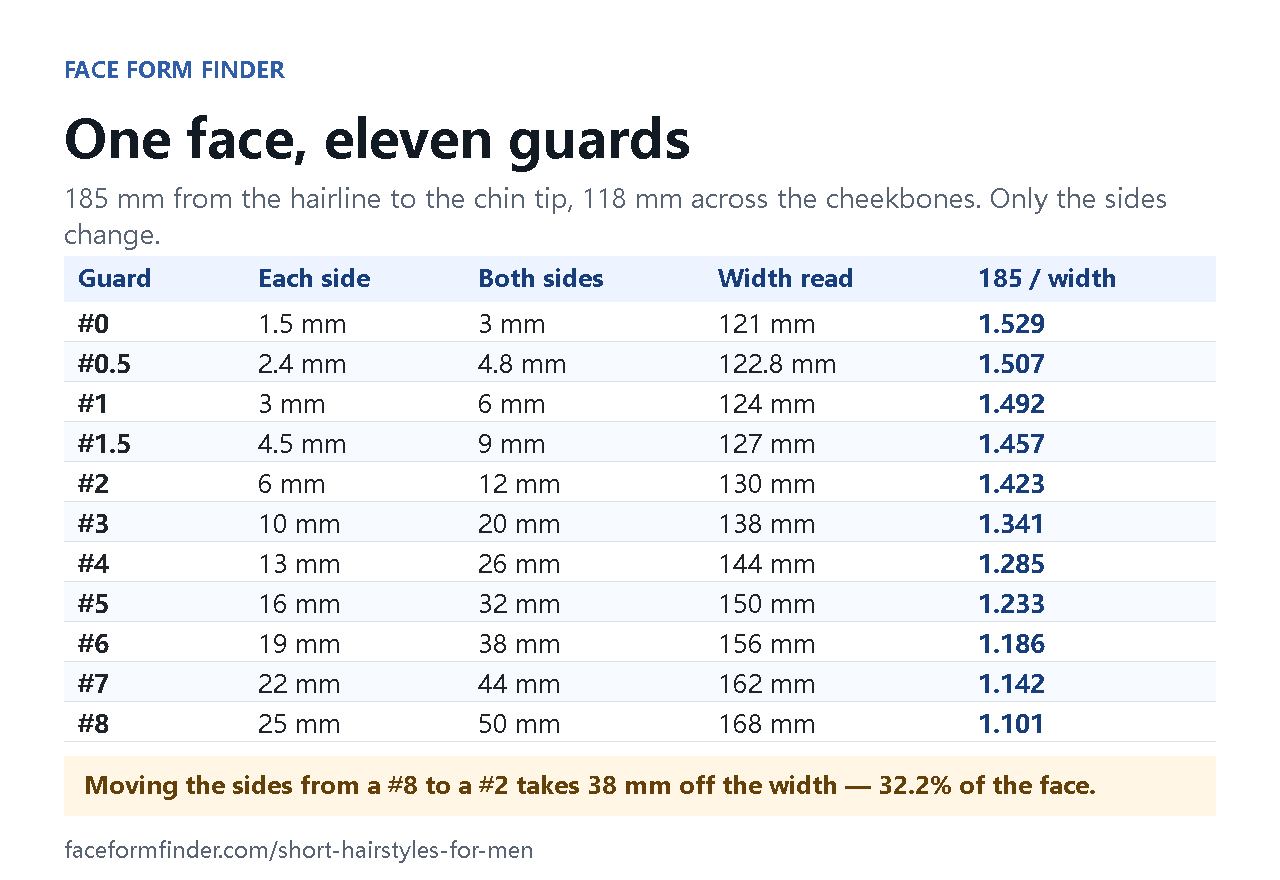
That figure is hair standing off the head, so it counts twice: once on each side. If your face measures 118 mm across the cheekbones and the clipper leaves 6 mm on each side, the outline reads 118 + 12 = 130 mm. The length does not change at all, because the hairline and the chin are exactly where they were.
| Guard | Left on each side | Added across both sides | Width the outline reads | 185 mm ÷ that width |
|---|---|---|---|---|
| #0 | 1.5 mm | 3 mm | 121 mm | 1.529 |
| #0.5 | 2.4 mm | 4.8 mm | 122.8 mm | 1.507 |
| #1 | 3 mm | 6 mm | 124 mm | 1.492 |
| #1.5 | 4.5 mm | 9 mm | 127 mm | 1.457 |
| #2 | 6 mm | 12 mm | 130 mm | 1.423 |
| #3 | 10 mm | 20 mm | 138 mm | 1.341 |
| #4 | 13 mm | 26 mm | 144 mm | 1.285 |
| #5 | 16 mm | 32 mm | 150 mm | 1.233 |
| #6 | 19 mm | 38 mm | 156 mm | 1.186 |
| #7 | 22 mm | 44 mm | 162 mm | 1.142 |
| #8 | 25 mm | 50 mm | 168 mm | 1.101 |
Two guards far apart on that list are worth putting side by side. Moving the sides from a #8 to a #2 takes 38 mm off the width — 32.2 per cent of the 118 mm face — and lifts the reading from 1.101 to 1.423. Nothing else moved. The hairline is where it was, the chin is where it was, and the face has not changed by a millimetre. Only the outline has.
The second number: what the top adds
Face length is read from the hairline down to the chin tip. That is what makes the top of the head awkward to talk about: the hair above the hairline sits outside the measurement, and it is also the only thing in the cut that can change how the measurement reads.
Adding it is the same arithmetic as the sides, but it goes on once instead of twice. Keep the sides at a #2 so the width stays at 130 mm, then add the top length above the 185 mm.
| Kept on top | In millimetres | Outline length | That length ÷ 130 mm |
|---|---|---|---|
| None (clippered to the hairline) | 0 mm | 185 mm | 1.423 |
| Half an inch | 12.7 mm | 197.7 mm | 1.521 |
| One inch | 25.4 mm | 210.4 mm | 1.618 |
| One and a half inches | 38.1 mm | 223.1 mm | 1.716 |
| Two inches | 50.8 mm | 235.8 mm | 1.814 |
| Three inches | 76.2 mm | 261.2 mm | 2.009 |
| Four inches | 101.6 mm | 286.6 mm | 2.205 |
One inch of hair on top over a #2 lands the reading on 1.618. That figure is worth noticing, because it is the number the golden-ratio face tools aim at, and here it arrives from nothing but a guard number and a trim length. The same inch on top over a #8 reads 1.252, because the sides are carrying 50 mm instead of 12. The top length did not change between those two answers. The sides did.
The endpoint nobody names
Every face-shape conversation starts at the hairline, and almost none of them says so. The line is the top endpoint of the face-length reading, which means the hair above it is excluded from the number by definition. A cut that leaves two inches on top has not made the face longer. It has put 50.8 mm of hair above the line the face is measured from, and that is what a viewer reads.
The top results use the word hairline, but for a different job: edging it, squaring it, keeping it clean, deciding where the fade stops near it. None of them uses it as a measurement endpoint, which is why none of them can explain what the top length changes. Once the hairline is the endpoint, the two numbers in a short cut stop being style choices and become the only two inputs that matter.
Where each style lands
Style names are still useful, but only as a shorthand for a pair of numbers. Read the two columns as inputs, not as descriptions, and each family lands on a different reading. Most short hairstyles for men are sold as one of these names; the name is the last thing on the list, not the first.
| Family | Kept on top | Sides at | Width read | Length read | Reading |
|---|---|---|---|---|---|
| Buzz cut | 13 mm | #4 | 144 mm | 198 mm | 1.375 |
| Crew cut | 19 mm | #2 | 130 mm | 204 mm | 1.569 |
| Caesar cut | 16 mm | #2 | 130 mm | 201 mm | 1.546 |
| French crop | 25 mm | #1 | 124 mm | 210 mm | 1.694 |
| Side part | 50.8 mm | #3 | 138 mm | 235.8 mm | 1.709 |
| High fade, textured top | 38.1 mm | #0.5 | 122.8 mm | 223.1 mm | 1.817 |
| Two block | 76.2 mm | #2 | 130 mm | 261.2 mm | 2.009 |
The spread across those seven families runs from 1.375 to 2.009, and every step of it came from moving one of the two inputs. A buzz cut and a crew cut differ by 6 mm on top and 7 mm per side, and they read 0.194 apart. That is the size of the decision you are actually making when you choose between them.
Your three numbers, in order
Two of the three you can take at home with a tape. The third one is the number you were going to give the barber anyway — it just needs to be in millimetres rather than in a name.
- Hairline to chin tip. Start at the centre of the hairline and go straight down to the point of the chin. Write it in millimetres.
- Widest point across the cheekbones. The same width the outline tables use, in millimetres.
- The pair you are asking for. The guard number for the sides, and the length you want kept on top. The guard chart converts the first; a ruler or a clipper manual converts the second.
Then the arithmetic is two lines. Width read = your width + twice the guard length. Length read = your length + the top length. Divide the second by the first and you have the reading your cut will produce before anyone picks up a clipper.
All three tables — the eleven guard rows, the seven top lengths and the seven style families — with the millimetres, the width and length each one reads, and the arithmetic behind them, as a CSV.
The 82-second version
If the player does not load, watch it on YouTube: Short Hairstyles for Men: The Two Numbers Your Cut Changes.
Questions
What is the most popular short haircut for men?
Nothing on this page answers that with a number, and neither do the pages that rank for short hairstyles for men. The gallery write-ups list cuts and put them in an order, which is an editorial choice rather than a count. Popularity and fit are also two different questions: the most photographed short cut in a given year can be the worst one for a face that reads 1.10 without hair on the sides. Decide the pair of numbers first, then use popularity only to pick a name for the result.
What is the 3 rule for short hair?
The question is asked as though there were one rule carrying that name, and the pages read for this term do not define one. In short-hair talk the number 3 is almost always a guard number, and on the guard chart a #3 leaves about 10 mm. Treated as a guard, the 3 answers how the sides are cut and says nothing about the length on top, which is the second of the two numbers. If someone gives you a rule of three with no unit attached, ask which of the two numbers it is meant to set.
What are the most popular short haircuts for men in 2026?
There is no tally behind the yearly lists, so the honest answer is a list of names rather than a ranking. What can be compared is what each named cut does to the two numbers. A crew cut carries 19 mm on top and a #2 at the sides; a two block carries 76.2 mm on top over a #2. Those two are the same year and the same category, and they read 1.569 and 2.009. Pick the reading you want, then take whichever name the current lists are using for it.
What is a good short haircut for older men?
Age changes the inputs, not the arithmetic. What tends to move with age is how much contrast a head carries comfortably — a very short side against a long top reads harder than the same pair did a decade earlier — and how often a trim is acceptable. Both are numbers you already have: the guard on the sides and the length on top. Set them, read the result, and then decide whether the maintenance interval that pair implies is one you will actually keep.
Related guides
- Haircuts for Men — the decision framework once the two numbers are set.
- Haircut Number Chart — every guard number pinned to its millimetre and inch value.
- Hair Length Chart — the top length in inches, centimetres and body landmarks.
- Medium Length Hairstyles Men — the band above this one, read by where the ends land.
- Face Shape Chart — the width and length readings that come before the cut.
- Facial Ratios — where the 185 mm and 118 mm fixed face is set out in full.
- Haircuts for a Round Face (Men) — the same two inputs, taken shape by shape.