FACE FORM FINDER · 4 OCTOBER 2026
Haircut for a Big Forehead
The band carries two readings, not one
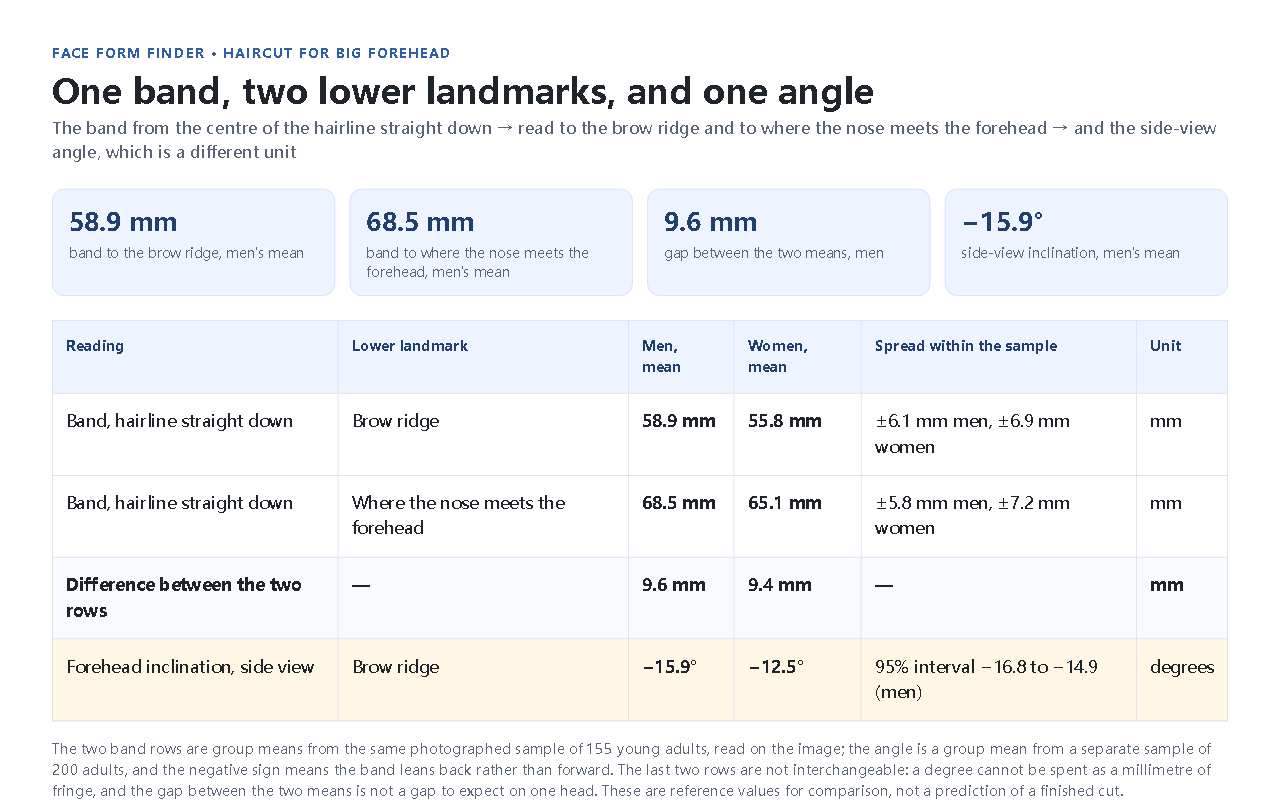
The pages that rank for this term are shelves of styles, and they are good ones. A style name tells you where the hair goes. It does not tell you how much of the forehead the hair has to cover, and that is the number the cut answers to. The band is the distance from the centre of the hairline straight down to a lower landmark, and two landmarks sit on that centre line. The first is the brow ridge, the most forward point between the eyebrows. The second is where the nose meets the forehead, a little lower again. Read to the first and the band is short. Read to the second and the same band is longer.
| Lower landmark | Men, mean | Women, mean | Spread within the sample |
|---|---|---|---|
| Brow ridge | 58.9 mm | 55.8 mm | ±6.1 mm men, ±6.9 mm women |
| Where the nose meets the forehead | 68.5 mm | 65.1 mm | ±5.8 mm men, ±7.2 mm women |
| Difference between the two rows | 9.6 mm | 9.4 mm | — |
Read the last row carefully, because it is easy to misuse. It is the distance between two averages taken on the same people with the same upper point, not a gap you should expect to find on your own forehead, and nothing on this page turns it into a fringe length. What it does say is that “big” is not a single number. The same head reads the shorter figure or the longer one depending on where the tape stopped, so two readings can only be compared when both used the same lower landmark and the same unit. Mix a brow-ridge reading with a nose reading and the comparison is worthless, however careful both measurements were.
The side view is a different quantity
Turn the head and the same band is described by an angle instead of a length. That angle is how far the line from the hairline down to the brow ridge leans back from vertical, and it has been measured on the same two landmarks, which makes it tempting to bolt the two systems together. They do not bolt. One is a length along the face in millimetres; the other is a lean away from the face in degrees, and a degree cannot be spent as a millimetre of fringe.
| Reading | Unit | What it describes | What it does not do |
|---|---|---|---|
| Band, hairline to the brow ridge | mm | a length in the plane of the face | does not describe how far the band leans |
| Band, hairline to where the nose meets the forehead | mm | the same band with the lower end moved down | does not describe a second forehead |
| Forehead inclination, side view | degrees | how far the band leans back from vertical | cannot be added to, or taken off, a millimetre reading |
In a photographed sample of 200 adults the inclination averaged −15.9° in men and −12.5° in women, and the negative sign is the whole point of it: negative means the band leans back rather than forward. A band that leans back can still be a short band, and a band that stands upright can still be a tall one. The angle is not a measure of how much forehead is on show, and it does not move when the front hair gets shorter.
What the cut changes, and what it does not
Every family in those style lists is aimed at one thing on this band: deciding how many millimetres of hair hang in front of it, and how far down those millimetres reach. That is the whole of a haircut's power here. The brow ridge stays where it is, the band keeps the length it measured, and the angle the band leans at does not change because the front was cut. What changes is how much of the band sits behind hair instead of in open air, and that is a difference you can see in a mirror the same afternoon.
It also settles a question the lists rarely ask: how often you have to come back. A front that has to reach a fixed point on the band grows out of place at the speed hair grows, so the shorter the target length, the sooner the shape stops matching the reading you took. A cut with a long front buys patience; a cut with a short front buys a calendar reminder. Both are honest answers, and the choice is yours to make rather than the barber's to guess.
Test the front on dry hair
A fringe measured wet is not the fringe you will wear. Wet hair pulls down and clumps together; dry hair lifts at the root, parts where it wants to and separates into strands, so a length that covered the band over the basin can leave a gap in front of the mirror. The check is done standing up, hair dry and styled the way you normally wear it. Comb the front forward, let it fall where it falls, and look at where the ends land against the band you measured. If the ends stop short of the point you chose, the length is not settled yet, and that is a conversation to have before the clipper goes across rather than after.
| Field | What goes in it |
|---|---|
| Lower landmark | Brow ridge, or where the nose meets the forehead — one of them, and the same one every time |
| The band | Your own reading in millimetres, in the unit the table above uses |
| Where the front hair lands, dry | The point the ends reach, read the same way as the band |
| The length you are willing to keep | In millimetres, or as a clipper number |
| Whether the cut keeps hair in front of the band | Yes or no — a swept-back or clipper-uniform front answers no |
Three things to say in the chair
- The landmark. Name the lower point you measured to. A barber who is told “my forehead is big” has to guess where you stopped measuring; a barber who is told which landmark you used is working from the same line you are.
- The reading and the target. Give the band in millimetres and the length you want left at the front, in the same unit. If the answer is a word rather than a number — tidy, neat, blended — the length that decides this page has not been set, and it is the one thing on the head that cannot be put back in the same visit.
- Whether hair stays in front. Say it plainly, because the whole difference between the two answers sits in that sentence. A front worn forward covers part of the band; a front slicked back leaves all of it in open air, on purpose.
The two bands with the millimetres and the spread, the side-view angle, and the record sheet to fill in before the cut, as a CSV.
The two readings on one card
Questions
What counts as a big forehead?
The usual shortcuts are finger widths laid across the band, and a threshold in centimetres above the eyebrow. Both are honest as far as they go, and both are describing the band this page is about. What neither of them fixes is the lower end. A band read to the brow ridge and the same band read to where the nose meets the forehead are 9.6 mm apart on average in men, which is wider than most of the cut-offs being quoted, so the number you compare yourself against should be the one you measured, to the landmark you chose.
Does a big forehead mean a receding hairline?
They are different measurements, and this page only runs the first one. A receding hairline is a change: the same band read now and read from an older photograph, with the distance between the two readings being the distance the line has travelled. A big forehead is a proportion: one band read once, against the face around it. The pages that treat the two as a single subject are describing a look rather than a measurement, and a band that has never moved can still read long.
Can a haircut make a forehead smaller?
It can change how much of the band sits behind hair, which is real and which you can see. It cannot change the band itself, the width across the forehead, or the angle the band leans at. Any page that promises the second has moved from describing a cut to describing a wish. What a cut can do is put a known number of millimetres in front of the band and hold them there until the hair grows past them.
Which haircuts leave hair in front of the band?
The ones whose front is worn forward: a crop or a fringe, a curtain parted in the middle, a side-swept front, a blunt fringe across the brow. The ones that do not are the clipper-uniform front and anything slicked back, which leave the band in open air on purpose. Which of the two you want is a choice rather than a verdict, and the tables above are what turn that choice into a measured one instead of a guess.
Related guides
- Receding Hairline Haircuts for Men — the same band read as a change over time, and the fringe length that returns it.
- Hairline Shapes — the four contours and the three heights, before the cut is chosen.
- Face Shape Chart — the thirds of the face, and how to check them at home.
- Facial Ratios — what happens to a reading when the same face is measured to two different endpoints.
- Haircuts for Men — the family list, once the front length is decided.
- Hair Length Chart — every guard number pinned to its millimetre value.