FACE FORM FINDER · 8 OCTOBER 2026
Brow Thickness
The tables below are worked out from the two bands and from nothing else, and the arithmetic is left visible so it can be repeated. This page is about reading a brow against its own face and about the two bands that are in use on that reading. It is not about which thickness looks better, and a number here is a reading rather than a score.
Why thickness is written as a ratio
A width in millimetres describes one brow on one face. Two people can carry the same brow width in millimetres and be read differently, because that width is a larger share of a narrow face than of a wide one.
The ratio divides one length by another length taken on the same face, so the size of the head drops out of the answer. The divisor is the distance between the inner corners of the eyes, corner to corner.
Because both lengths are taken on the same face, the ratio does not change with the size of the photograph the reading was taken from. A figure in millimetres does.
The two bands on one axis
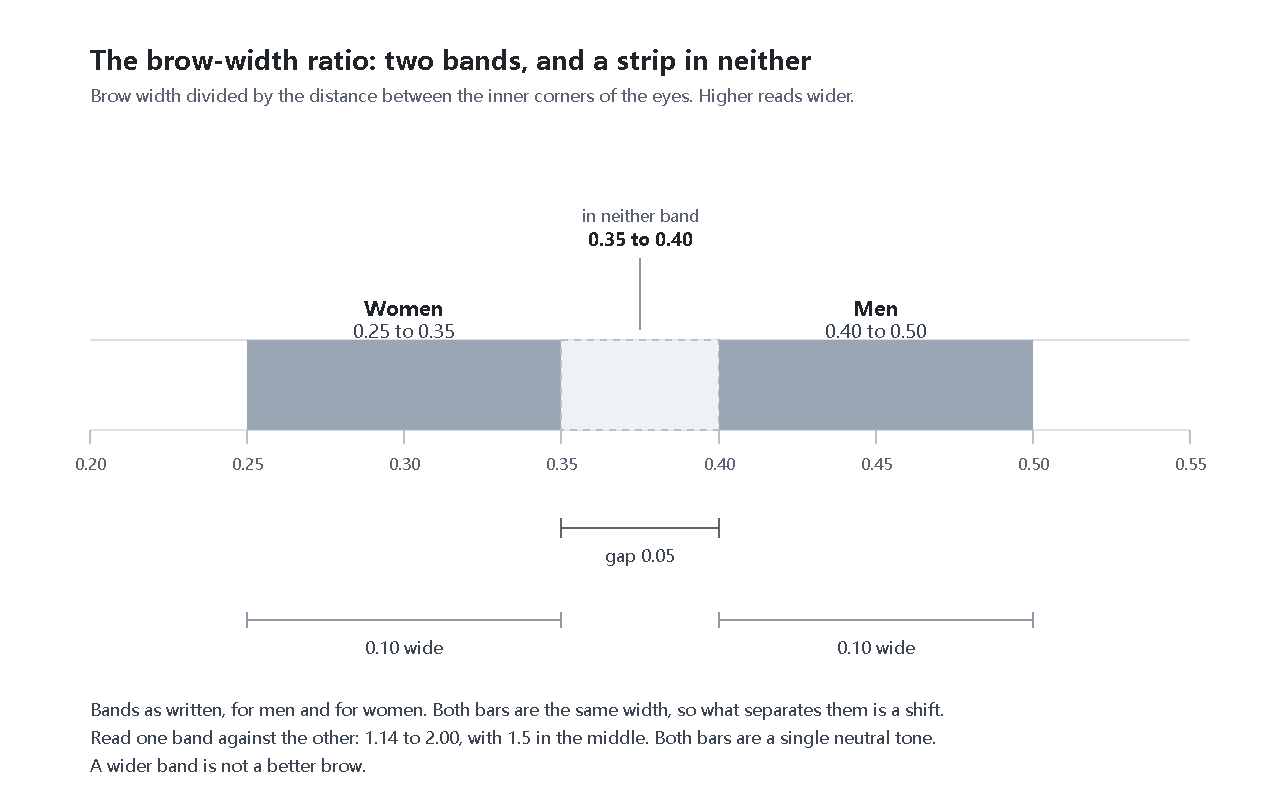
Two bands are in use on this ratio. They are set out below as they are written, one for men and one for women.
| Band | Low end | High end | Width of the band | Where it sits |
|---|---|---|---|---|
| Men | 0.40 | 0.50 | 0.10 | Above the women's band, with a gap of 0.05 below it |
| Women | 0.25 | 0.35 | 0.10 | Below the men's band, with a gap of 0.05 above it |
| The strip between them | 0.35 | 0.40 | 0.05 | In neither band |
Both bands are measured group values, quoted as they are written, and they were read from the eyebrow shape chart this page works from on 2026-10-08.
Three things fall out of the table, and each of them is worked out from the two bands alone. The two bands do not touch: the male floor of 0.40 sits 0.05 above the female ceiling of 0.35. Both bands are 0.10 wide, so what separates them is a shift of the whole band rather than a wider or a narrower band, and the women's band is the men's band moved down by 0.15. The strip between them, 0.35 to 0.40, is 0.05 wide, which is half the width of either band.
A reading that lands in that strip is above the women's band and below the men's band. There is no figure that sits in both bands, so a single reading cannot meet both of them.
The multiple between the two bands
The two bands can be set against each other at more than one point, and the answer moves with the point chosen. Each row below divides one band by the other, and both come from the same ratio, so no length in millimetres enters the arithmetic.
| Read as | Arithmetic | Multiple | What it sets against what |
|---|---|---|---|
| Thin end against thin end | 0.40 ÷ 0.25 | 1.60 | The male floor against the female floor |
| Thick end against thick end | 0.50 ÷ 0.35 | 1.43 | The male ceiling against the female ceiling |
| Middle against middle | 0.45 ÷ 0.30 | 1.50 | The middle of one band against the middle of the other |
| Male floor against female ceiling | 0.40 ÷ 0.35 | 1.14 | The smallest multiple the two bands allow |
| Male ceiling against female floor | 0.50 ÷ 0.25 | 2.00 | The largest multiple the two bands allow |
| Across the four corners | — | 1.14 to 2.00 | The span of the multiple over the whole of both bands |
Each figure in the table is worked out on 2026-10-08 by dividing one end of a band by one end of the other. The 1.5 that is quoted most often is the middle-against-middle row. It is the centre of the range rather than a fixed figure, and the range itself runs from 1.14 to 2.00.
The multiple is larger at the thin end than at the thick end: 1.60 against 1.43 when like is read against like. That is arithmetic on two bands of the same width, and it happens because dividing a smaller pair of numbers gives a larger answer than dividing a bigger pair the same distance apart.
The multiple is worked out between the two bands. It is not either band turned into millimetres: a millimetre figure for a band needs a fixed face length, or a fixed divisor, chosen first, and that choice is a different operation from setting one band against the other.
How the reading is taken
Two lengths are needed, both on the same face and both from the same picture: the width of the brow, and the distance between the inner corners of the eyes. Divide the first by the second.
Neither length has to be converted, because the division cancels the units, so a reading taken from a photograph at the wrong size still gives the same number.
The two bands above are written on this reading. A brow that divides out inside one of them is inside that band; a brow that divides out between 0.35 and 0.40 is in neither.
What the ratio does not contain
The word thickness, as it is used day to day, means the depth of a brow from top to bottom. The ratio above is written as brow width, and this page does not treat the two as the same axis. The bands are quoted as they are written, and a reading taken across a brow rather than up and down it is not the same reading.
Density, the number of hairs, colour, and the state of a brow after shaping, tinting or transplanting are not in the ratio. Neither is the difference between a person's two brows.
The two bands come from a reading of 1,482 East Asian faces. That set is narrow in the same way as the other readings on this site: it is a young set, and it covers a small number of ancestries, so a brow outside it is not described by it. The bands are group values rather than targets, and a reading that falls outside both is not a fault.
The two bands, the strip between them, and the multiple read five ways, as a CSV.
One ratio, two bands, and a strip between them
Questions
What is the ideal thickness for eyebrows?
The reading that is in use is a ratio rather than one figure: brow width divided by the distance between the inner corners of the eyes. Two bands are written on it, 0.40 to 0.50 for men and 0.25 to 0.35 for women, and they do not touch. A single reading cannot sit in both, and the strip from 0.35 to 0.40 sits in neither.
How do you know how thick your eyebrows should be?
Take two lengths on your own face, the width of the brow and the distance between the inner corners of the eyes, and divide the first by the second. The answer is a number with no units. Compare it with the two bands above: a number inside a band is inside it, and a number between the bands is in neither.
What is the average brow width?
The two bands are ranges rather than averages. The middle of each band is worked out at 0.45 for men and 0.30 for women, and those are the two figures used in the middle-against-middle row above.
Is brow thickness the same as eyebrow thickness?
They are the same term written two ways, and they are read the same way here. One ratio and one pair of bands cover both.
Does the multiple between the bands change with the size of a face?
No. The two bands are written on a ratio, and dividing one band by the other is arithmetic on two numbers that carry no units, so the multiple is the same whatever the size of the face. What changes with the size of a face is a figure in millimetres, not the multiple.
Related guides
- Eyebrow Shape Chart — the six distances behind a brow shape, and the two ratios this page works from.
- Eye Shape Chart — the eye opening the brow sits above, as seven readings.
- Face Shape Chart — the four widths and the length that build a face shape.
- Canthal Tilt — another reading taken as one length over another on the same photograph.
- Hairline Shapes — the line above the brow, read the same way.