Face Form Finder · contour
How to Contour a Round Face
Four tape numbers and one division decide where the band starts and how wide it is.
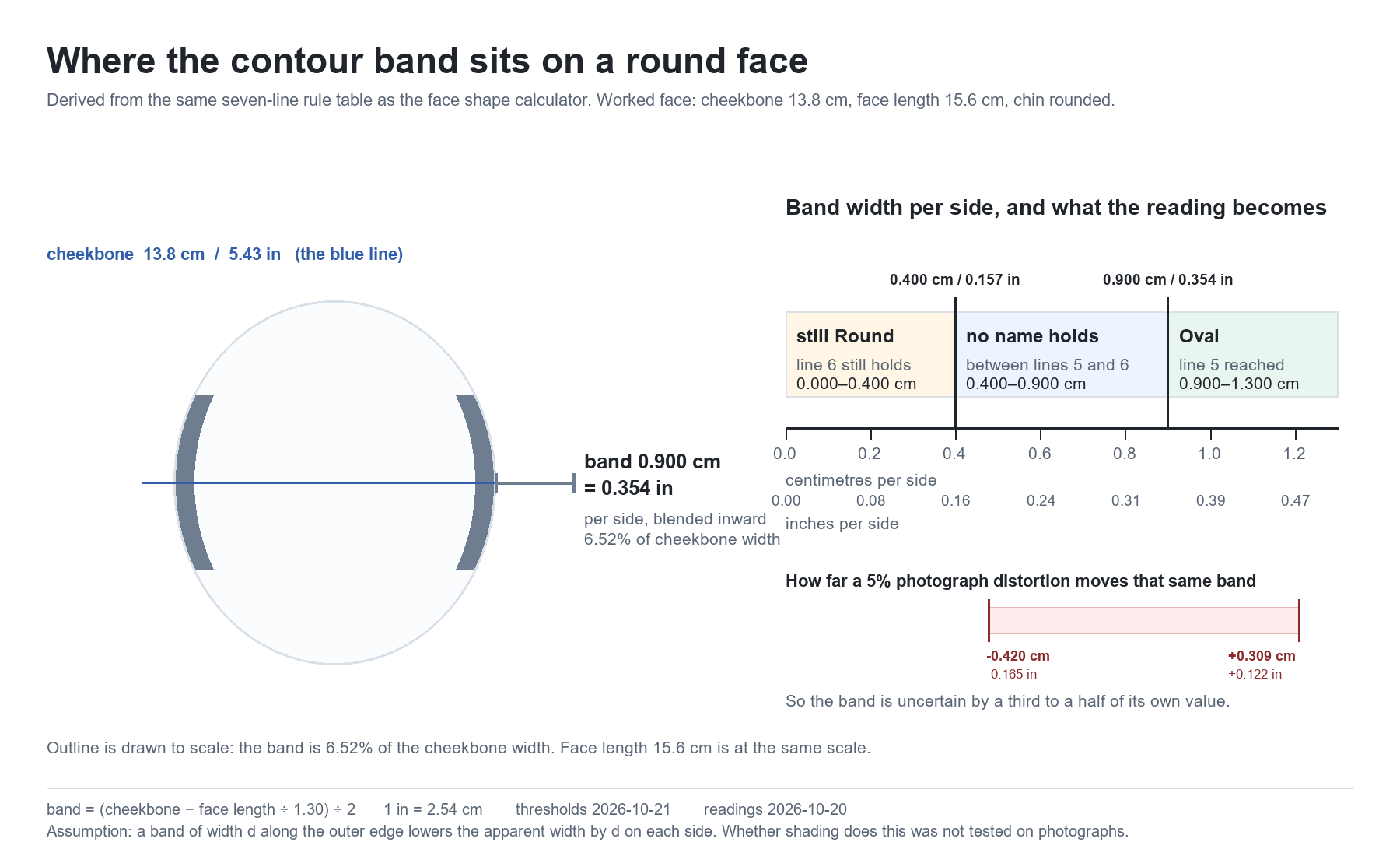
On the worked face below — cheekbone 13.8 cm (5.43 in), face length 15.6 cm (6.14 in) — that is 0.900 cm (0.354 in) per side, or 6.52% of the cheekbone width. Both of those are calculated from the formula, not measured on a face. The 1.30 is the Oval line in the seven-line table this site's calculator uses; the 1.20 in the same table is where the face stops being Round. Those two numbers set the floor and the ceiling of the band.
Below 0.400 cm (0.157 in) per side the reading stays Round. Between 0.400 cm and 0.900 cm per side there is a strip where no name in the table holds at all. At 0.900 cm the reading reaches Oval.
Both files are built from the numbers on this page, and every row in the data file carries its own arithmetic so you can recompute it:
- contour-round-face-band-chart.csv — the four rulers and the band width each one implies, the six distortion rows with the cheekbone they back-solve to, and the same band for five points of the 28-reading reference set, in centimetres and inches.
- contour-round-face-band-map.png — the band drawn to scale against a 13.8 cm cheekbone, with the three zones marked and the distortion bar beside them.
If you would rather check the arithmetic before using either file, the four steps are written out further down.
The four rulers, and what each one decides
The calculator here compares seven names in a fixed order. Three of the four tape numbers enter as ratios, and each of those ratios has one threshold that matters once a face is already reading as Round. The fourth number, the chin outline, has no threshold at all — it is a switch, not a scale.
| Ruler | Threshold | Reading on this face | Band per side | What the reading becomes |
|---|---|---|---|---|
| length ÷ cheekbone | 1.20 | 1.130 | 0.400 cm / 0.157 in | no name holds |
| length ÷ cheekbone | 1.30 | 1.130 | 0.900 cm / 0.354 in | Oval |
| jaw ÷ cheekbone | 0.90 | 0.913 | 0.090 cm / 0.035 in | no name holds |
| forehead ÷ cheekbone | 0.90 | 0.935 | 0.240 cm / 0.094 in | no name holds |
| chin outline | none | rounded | no distance follows | flips Round to Square |
Inch values are calculated from the centimetre ones at 1 in = 2.54 cm, the definition of the inch, and rounded to three decimals. The centimetre values come from the formulas in the table below.
The arithmetic behind each row
| Ruler | Formula | Numbers put in | Result |
|---|---|---|---|
| length ÷ cheekbone, to 1.20 | (cheekbone − length ÷ 1.20) ÷ 2 | (13.8 − 15.6 ÷ 1.20) ÷ 2 | 0.400 cm |
| length ÷ cheekbone, to 1.30 | (cheekbone − length ÷ 1.30) ÷ 2 | (13.8 − 15.6 ÷ 1.30) ÷ 2 | 0.900 cm |
| jaw ÷ cheekbone, to 0.90 | (jaw − 0.90 × cheekbone) ÷ 2 | (12.6 − 0.90 × 13.8) ÷ 2 | 0.090 cm |
| forehead ÷ cheekbone, to 0.90 | (forehead − 0.90 × cheekbone) ÷ 2 | (12.9 − 0.90 × 13.8) ÷ 2 | 0.240 cm |
Every one of those formulas divides by two because the band goes on both sides of the face. Shading one cheekbone edge takes width off that edge only; the width the table compares is the full span across the face, so half the change has to come from each side.
Two of the three numeric rulers are cliffs, not ramps
Only one ruler has a ramp from Round to a named band, and it is the length ratio. Push the length ratio up and the face passes through the unnamed strip and arrives at Oval, which is a real line in the table.
The jaw ratio does not behave that way. Take the jaw from 0.913 to just under 0.90 — a band of 0.090 cm (0.035 in) per side — and every line in the table fails at once. The face is not Triangle, which needs a jaw ratio of 1.02 or more. It is not Heart, which needs a forehead ratio of 1.02 or more. It is not Diamond, which needs both widths under 0.90. And it is no longer Round, because Round requires the jaw ratio to be 0.90 or more. The calculator's answer becomes “between two names”.
The forehead ratio is the same story at 0.240 cm (0.094 in) per side. Both of these rulers are exits into the unnamed strip, not routes to a better name.
That is a property of the seven-line table, not a claim about how anyone looks. It is also the reason the margin matters more than the label: the worked face sits 0.013 away from the jaw line and 0.070 away from the length line, so the jaw is where a small change moves the answer first.
What a 5% distortion does to that same band
One photograph was re-read five ways on 2026-10-20. Its own length ratio, before any edit, was 1.2085. The band columns are all computed on a single face — the worked face above, cheekbone 13.8 cm and face length 15.6 cm, whose own length ratio is 1.1304. Each row takes the change the edit made to the photograph's ratio and applies that same change to 1.1304, then recomputes the band from the new ratio. So every row is the same face seen at a different ratio; put any row's ratio and band back into the formula and the cheekbone comes out 13.8 cm again.
| Condition | Photo ratio before | Photo ratio after | Change in ratio | Ratio on the worked face | Band per side after | Change in band |
|---|---|---|---|---|---|---|
| As first read | 1.2085 | — | — | 1.1304 | 0.900 cm / 0.354 in | — |
| Squeezed vertically 5% | 1.2085 | 1.1502 | −0.0583 | 1.0721 | 1.209 cm / 0.476 in | +0.309 cm / +0.122 in |
| Stretched vertically 5% | 1.2085 | 1.2877 | +0.0792 | 1.2096 | 0.480 cm / 0.189 in | −0.420 cm / −0.165 in |
| Rotated 5° in the picture plane | 1.2085 | 1.2085 | 0.0000 | 1.1304 | 0.900 cm / 0.354 in | 0.000 cm |
| Narrowed horizontally 3% | 1.2085 | 1.2500 | +0.0415 | not derived | not derived | not derived |
| Narrowed horizontally 5% | 1.2085 | 1.2857 | +0.0772 | not derived | not derived | not derived |
The two horizontal rows are marked “not derived” on purpose. Those edits changed the face length as well as the width — in the 5% case the saved length went from 255 to 261 pixels — so the band cannot be recomputed as though the cheekbone width had been held still. Reporting a number there would be arithmetic on an assumption the test does not support.
What the three clean rows show is the size of the problem. A 5% change in one direction moves the band by 0.309 cm to 0.420 cm, which is 34% to 47% of the 0.900 cm value itself. Rotation in the plane moved nothing, so the shift comes from the proportions of the frame rather than from a tilted head. If your four numbers came from a photograph, the band you compute is only as firm as the photograph behind it.
One thing in that column is an approximation rather than a measurement: a distortion acts on the ratio proportionally, while the column above adds the change to the worked face's 1.1304 as a fixed amount. The two treatments do not give the same number, and the additive form is the one this page uses.
How to check this on your own face
Four measurements with a tape, then two divisions. Nothing here needs a photograph, and nothing is sent anywhere.
- Forehead width at its widest point, cheekbone width at its widest point across the face, jaw width at its widest point, and face length from hairline to the bottom of the chin. Use one unit for all four; the ratios cancel the unit out.
- Divide face length by cheekbone width. That is the length ratio, the one number that has a ramp to a named band.
- Divide face length by 1.30, subtract the result from your cheekbone width, and halve it. That is the band per side that reaches the Oval line.
- Divide face length by 1.20 and repeat. That is the width at which the reading stops being Round. Anything between that number and the previous one lands in the strip where no name holds.
A worked conversion, in inches
Suppose the tape reads 5.43 in across the cheekbones and 6.14 in from hairline to chin. One inch is exactly 25.4 millimetres, so 1 in = 2.54 cm and the two readings become 5.43 × 2.54 = 13.7922 cm and 6.14 × 2.54 = 15.5956 cm.
The length ratio is 15.5956 ÷ 13.7922 = 1.1308. Divide the length by 1.30: 15.5956 ÷ 1.30 = 11.9966 cm. Subtract that from the cheekbone width: 13.7922 − 11.9966 = 1.7956 cm. Halve it for the two sides: 1.7956 ÷ 2 = 0.8978 cm. Back to inches: 0.8978 ÷ 2.54 = 0.3535 in.
These inch inputs give 0.8977923 cm, or 0.3534615 in, per side under the formula: 0.898 cm and 0.353 in to three decimals. The answer box uses different inputs, 13.8 cm and 15.6 cm, giving 0.900 cm and 0.354 in. Keep unrounded values through the calculation and round only the final display.
The same band, for five points of the reference set
The 28 photograph readings behind the round-faced measurement page were taken on 2026-10-20. Their length ratios run from 1.0623 to 1.4252, with 13 of the 28 under 1.20 and 15 at or above it. Read as a band requirement, that spread looks like this at a 13.8 cm cheekbone width:
| Point in the set | Length ratio | Band per side | Share of cheekbone |
|---|---|---|---|
| Lowest | 1.0623 | 1.2616 cm / 0.4967 in | 9.14% |
| Lower quarter | 1.1601 | 0.7425 cm / 0.2923 in | 5.38% |
| Middle | 1.2006 | 0.5276 cm / 0.2077 in | 3.82% |
| Upper quarter | 1.2204 | 0.4225 cm / 0.1663 in | 3.06% |
| Highest | 1.4252 | 0 cm / 0 in | 0% |
The highest row is zero because a ratio of 1.4252 already sits above the 1.30 line; no band is needed to reach it. The lowest row needs 1.2616 cm (0.4967 in) per side, which is 9.14% of the cheekbone width and 2.39 times the 0.5276 cm that the middle row needs. The band widens fast as the ratio falls, because the distance to the 1.30 line is what is being divided by two.
The photograph ratios above are inputs to a hypothetical calculation at a fixed 13.8 cm width, not calibrated tape measurements. No photograph-to-tape calibration was performed for length, cheekbone, forehead or jaw measurements. These calculations do not establish a measured contour effect.
What was not measured
| Thing | Status | Why |
|---|---|---|
| Whether shading lowers the perceived width by exactly the band width | not measured | The formulas above assume a band of width d along the edge takes d off each side. That is geometry, not a result. No photograph test of the assumption was run here. |
| Tape error | not measured | The 28 readings behind the reference set came from photographs, not tapes. No tape-against-photograph calibration was made, so the two cannot be mixed inside one calculation. |
| Lens focal length | not measured | The five distortions were edits to one existing image, not changes of camera or lens. No focal-length comparison of one face was made. |
| Behaviour across different faces | not measured | The five distortions come from one photograph, so they are a set of readings on one face, not rates across people. |
| Whether the result looks better | not measured | This page computes where a band sits and which name the resulting reading lands on. It does not score appearance, and nothing here establishes that reaching Oval is preferable. |
Lines on this page that are not on the other pages here
Six statements, each of which needs both the threshold table and the tape arithmetic to exist, and none of which appears on the calculator page, the measurement page or the chart page:
- The contour band on a round face has a computable width: (cheekbone width − face length ÷ 1.30) ÷ 2, which is 0.900 cm (0.354 in) per side on a 13.8 cm cheekbone with a 15.6 cm face length.
- There is a strip of band widths between 0.400 cm and 0.900 cm per side where the seven-line table returns no name at all, and it is a consequence of the 1.20 and 1.30 lines rather than of any measurement.
- Breaking the jaw condition with a 0.090 cm (0.035 in) band per side does not move the face to another name; it moves it out of every name in the table, and the forehead condition does the same at 0.240 cm (0.094 in).
- The chin outline is the only one of the four tape entries with no threshold, so no distance can be derived from it, and it acts as the switch between Round and Square rather than as a scale.
- A 5% distortion of the photograph moves the band by 0.309 cm to 0.420 cm, which is 34% to 47% of the band's own value, while rotation in the plane moves it by nothing.
- At the lowest length ratio in the 28-reading set, the band needed to reach the 1.30 line is 1.2616 cm (0.4967 in) per side, which is 2.39 times the band the middle of the set needs at the same cheekbone width.
If a line above turns out to be on another page here, it is not exclusive and should be removed rather than reworded.
Where this sits next to the other pages
For the four inputs and the seven-line table this page borrows, use the face shape calculator. For the 28 readings the reference set is drawn from, use the measured faces. If you would rather see the seven names drawn as bands along a single axis than as ratios, the face shape chart has that view. The face analyzer page takes one image file and reads it twice, which is the shortest demonstration of what a photograph can and cannot carry.