Face Form Finder
Beard Cheek Line: choose the line before you trim it
Keep the natural upper edge for the first pass. If you want a cleaner line, choose two points that are already supported by dense growth, remove only the hairs above the line, then live with the result before taking another pass. A cheek line is easy to lower and slow to grow back.
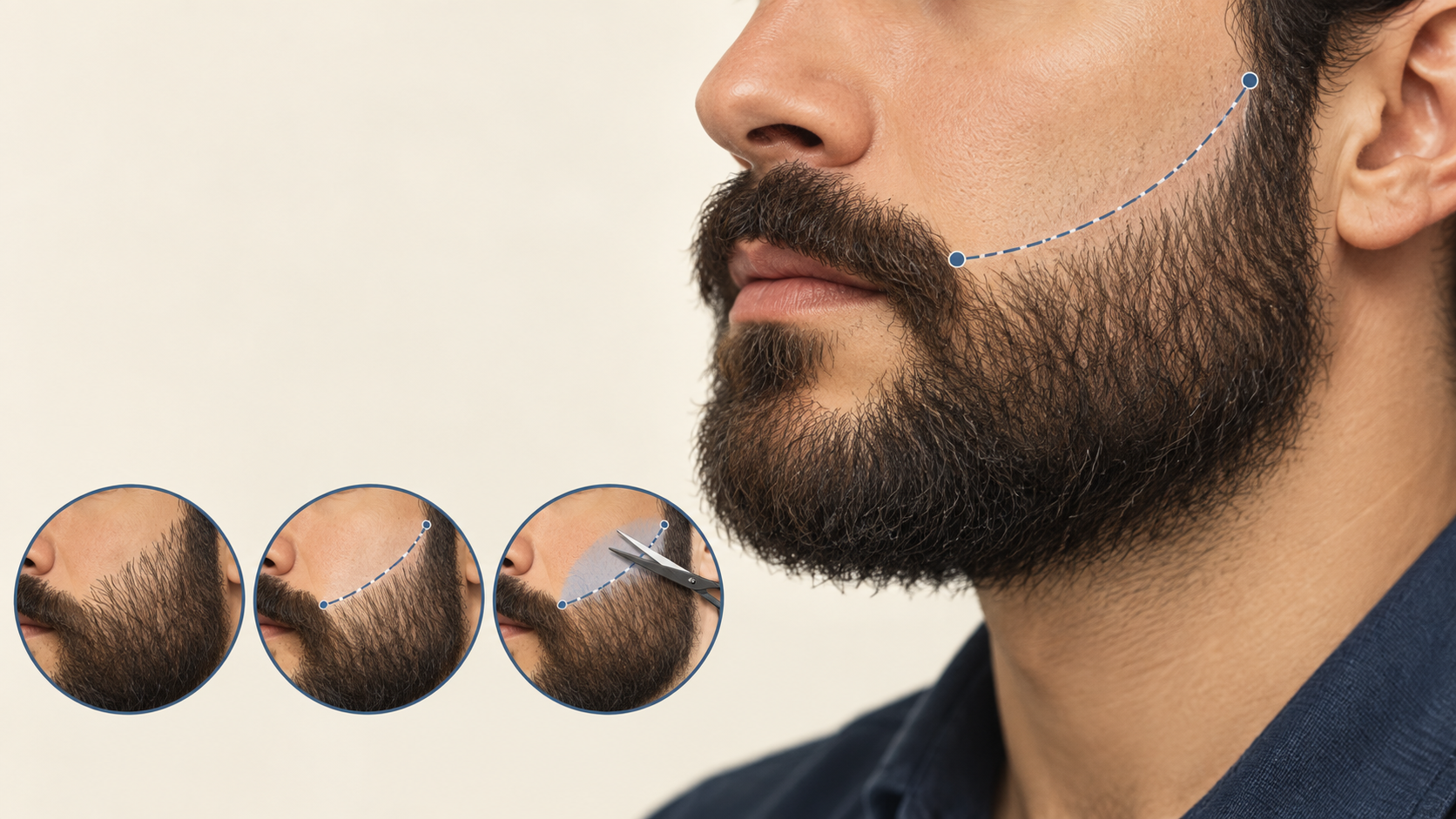
Use the three-pass decision sheet
This is a grooming decision tool, not a face measurement or a universal rule. It is designed to make the irreversible part—removing hair—the last thing you do.
| Pass | What to look at | Choose this result when | What to do |
|---|---|---|---|
| 1. Leave it alone | Look at the top edge with the beard dry and combed down. | The edge is mostly continuous and the unevenness is only a few isolated hairs. | Keep the natural line. Snip only obvious hairs that sit well above it. Do not draw a new boundary. |
| 2. Find two supported points | Find one point beside the sideburn and one point near the moustache where growth is clearly dense. | Both points are visible without stretching the skin or inventing extra height. | Mark those two points with a washable pencil. If either point sits in sparse growth, lower neither point; return to pass 1. |
| 3. Test the finish | Stand back from the mirror and compare the marked path with the beard’s own upper edge. | A straight path looks deliberate, or a shallow curve follows an existing curve without cutting into fullness. | Remove hair only above the guide. Stop, wash away the mark, and wait before deciding whether any correction is needed. |
Natural, straight, or soft-curved?
These are finishes, not rankings. The right one is the finish that preserves the most convincing part of your own growth.
| Finish | Use it when | Stop signal |
|---|---|---|
| Natural | Your upper edge already has a clear direction and you would only be cutting into dense hair to make it look sharper. | Do not turn normal variation into a new line just because one side is not identical to the other. |
| Straight | The two dense endpoints make a clean diagonal without crossing a sparse patch. | Do not force the line lower simply to make the angle more dramatic. |
| Soft-curved | Your natural edge rises or falls gently and a straight guide would remove a visible wedge of good growth. | Do not make a deep arc. A large scoop usually reads as a haircut choice, not a correction. |
Trim one side without losing the other
- Comb downward and look at normal distance. A close-up mirror makes every single hair look like a defect. Decide from the distance where another person would see the line.
- Mark the path before switching on a trimmer. The mark is a proposal. If it makes the beard look thinner before any hair is removed, erase it and choose a higher path.
- Clear above the guide in short strokes. Keep the trimmer on the skin above the line. Do not run it along the guide itself until the loose hair is gone.
- Pause after the first side. Turn your head slightly, then compare the endpoint and slope from a normal viewing distance. Match the decision, not every individual hair.
- Wait before a second correction. A fresh edge can look sharper than the beard beside it. Give the shape time to settle before lowering either side again.
When growth is patchy near the cheek
Patchiness is a reason to preserve more hair, not a reason to draw a more ambitious line. Use the densest visible edge as the boundary and accept a softer finish above it. If the left and right sides grow to different heights, choose the highest credible line each side can support; forcing both to the lower side may create matching lines but a thinner beard.
For a complete beard shape, the cheek line is only one edge. Check it with the neckline and the beard length you are keeping; the beard styles for face shapes guide compares practical length examples, and the beard neckline guide covers the lower boundary.