Hair growth rate by group
Read the measured growth-rate figures when the question is how fast hair grows.
Face Form Finder
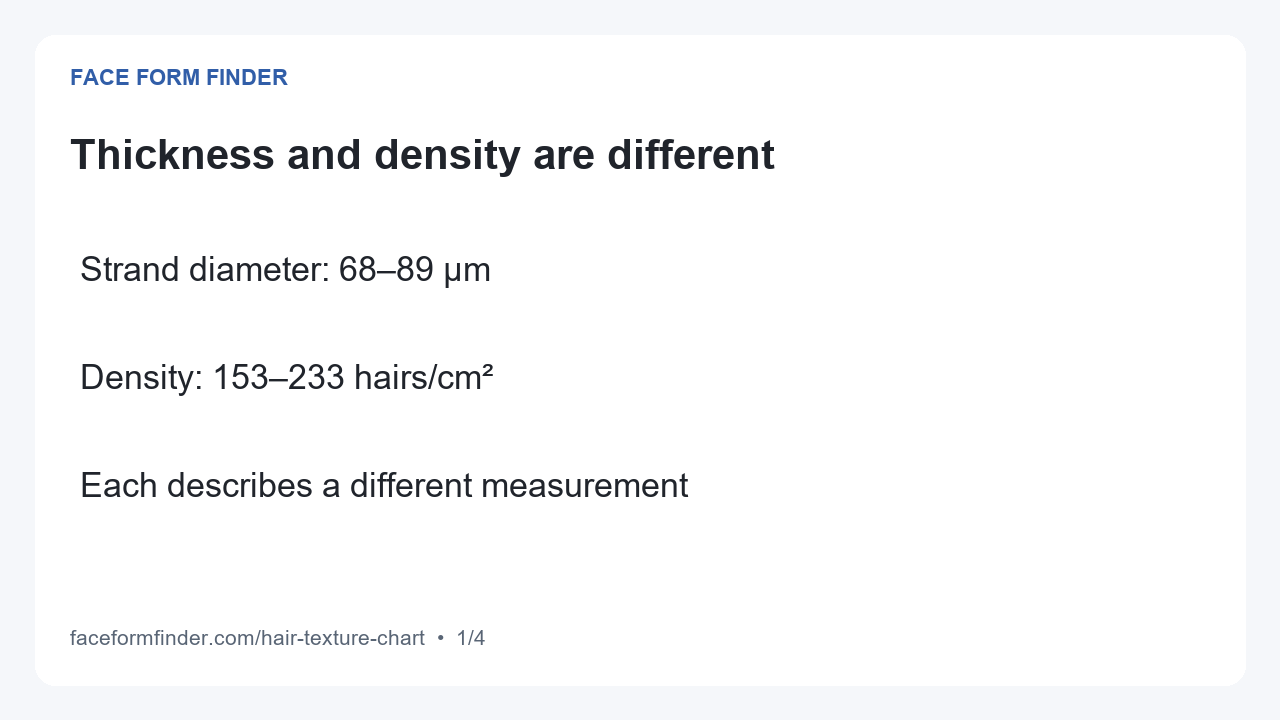
Measured group by group, each reading varies across a band. Across 24 ethnic groups the mean strand diameter runs from 68 µm (South-African) to 89 µm (Chinese), and mean density runs from 153 hairs per cm² (South-African) to 233 (French). The two stay apart throughout this page: one is the width of a single strand, the other is how many strands grow in an area of scalp.
Each row is one ethnic group, carrying the group’s sample size and its two readings in separate columns. Strand diameter is the width of one fibre; density is how many hairs grow in a square centimetre of scalp. The two columns do not move together: the group at the top of one is not the group at the top of the other.
| Ethnic group | n | Strand diameter (µm) | Density (hairs per cm²) |
|---|---|---|---|
| African-American | 64 | 71 | 176 |
| Brazilian | 184 | 77 | 221 |
| Caribbean | 97 | 73 | 178 |
| Caucasian-American | 55 | not measured | 206 |
| Caucasian-Australian | 58 | not measured | 225 |
| Chinese | 249 | 89 | 172 |
| Danish | 70 | 74 | 214 |
| French | 86 | 69 | 233 |
| Indian | 177 | 79 | 202 |
| Japanese | 56 | 86 | 167 |
| Kanak | 64 | not measured | 168 |
| Korean | 96 | 88 | 164 |
| Latino-American | 58 | not measured | 208 |
| Lebanese | 56 | not measured | 218 |
| Mexican | 92 | not measured | 215 |
| North-African | 85 | 78 | 203 |
| Peruvian | 90 | not measured | 202 |
| Polish | 60 | 72 | 210 |
| Russian | 59 | not measured | 202 |
| Scottish | 90 | 72 | 211 |
| South-African | 114 | 68 | 153 |
| Spanish | 50 | 79 | 215 |
| Thai | 87 | 87 | 183 |
| Western-African | 152 | 78 | 165 |
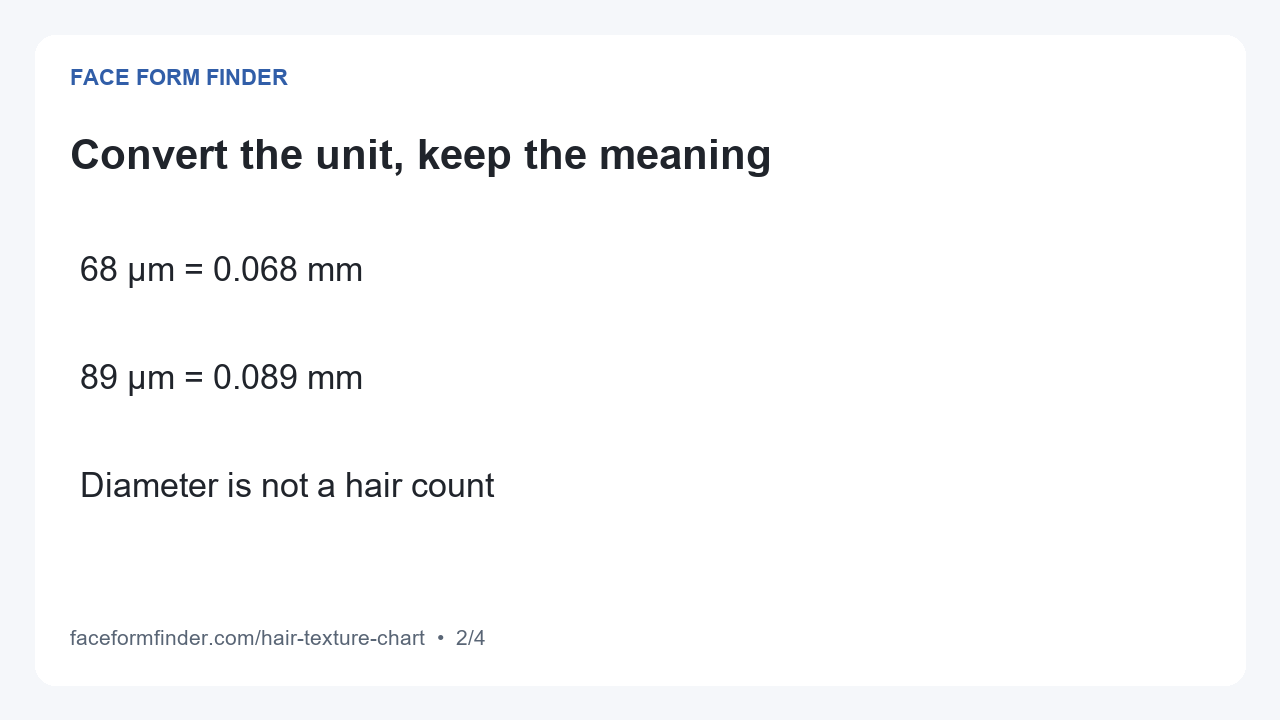
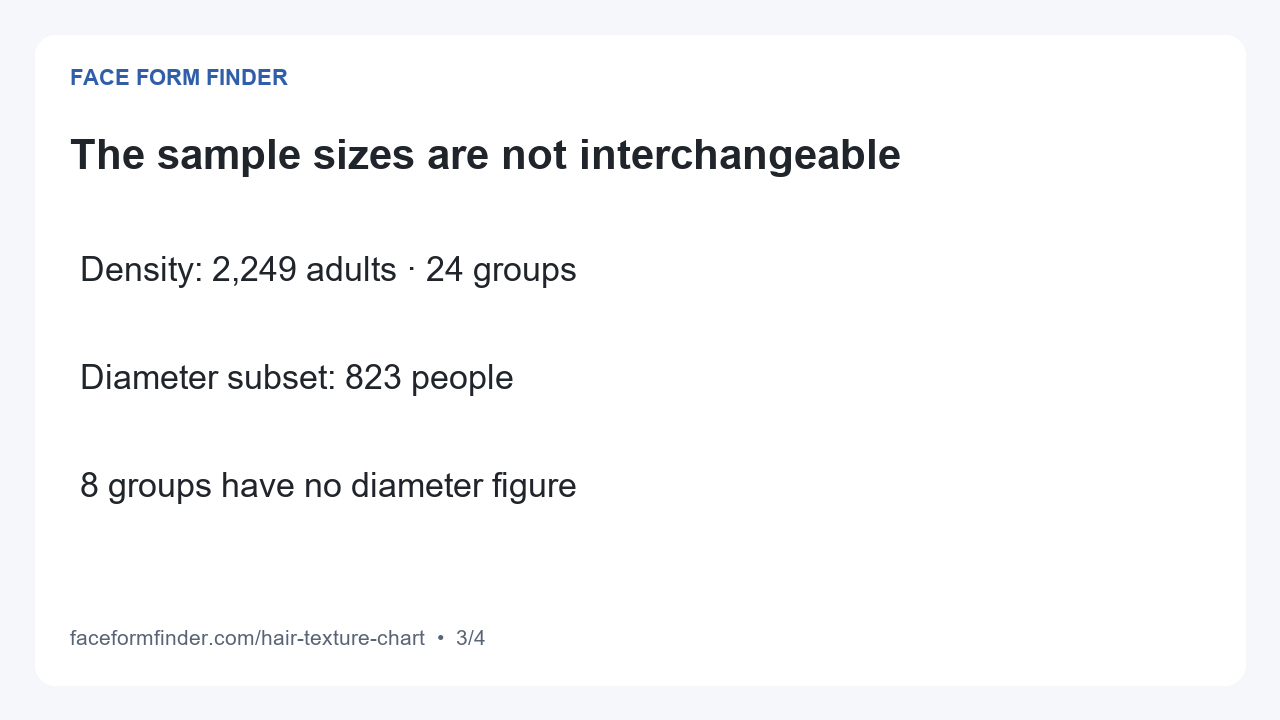
Strand diameter is given in micrometres (µm). One micrometre is one thousandth of a millimetre, so 68 µm is 0.068 mm, 79 µm is 0.079 mm and 89 µm is 0.089 mm. Density is given in hairs per square centimetre. The n column is the number of people measured in that group for density; strand diameter was measured on a smaller subset of the same people (823 of the 2,249), from 15 of the countries covered, so a group’s diameter figure rests on fewer people than its n, and eight of the 24 groups have no diameter figure at all. Each figure shown is the mean for its group; the diameter recorded for one person is itself a median taken across several pieces of that person’s own sample.
Both columns are group readings, not personal targets, and each is a band rather than a single figure. Strand diameter runs from 68 µm (South-African) to 89 µm (Chinese), a 21 µm gap; density runs from 153 hairs per cm² (South-African) to 233 (French), a gap of 80. South-African sits at the bottom of both columns, and no group leads both: the widest strands are Chinese at 89 µm, the densest scalp is French at 233 hairs per cm².
The 80 hairs-per-cm² gap between the two ends of the density column is only slightly wider than the standard deviation inside the top group alone. The French figure carries a standard deviation of 74 hairs per cm² and the South-African figure a standard deviation of 30, so the distance between the two most extreme group means (80) is barely more than the standard deviation within one of them (74). A reading below a group’s own figure is therefore still ordinary for that group.
The names below are common beauty-industry and consumer descriptions, not clinical categories or official standards. Use two separate observations: the feel and visibility of one strand, and the amount of hair you can see across an area of your scalp.
| Observation band | How to recognise it | One strand of hair | A whole area of hair | What it can mean for everyday handling |
|---|---|---|---|---|
| Fine strands | A clean, shed strand feels light between finger pads and can be hard to notice against a plain card without close attention. | The individual fibre feels delicate rather than wire-like. Fine describes thickness, not how much hair you have. | You may still have a full-looking head of hair if many fine strands grow in each area. | Use gentle handling when your own strands tangle or snap easily, and judge added weight by how your hair behaves rather than by the label alone. This is a general practice, not a product rule. |
| Medium strands | A strand is easy to locate and feel, but it does not feel unusually resistant or wire-like. | The fibre sits between the fine and coarse descriptions in your own comparison. | Density can still be low, medium, or high; medium strand thickness does not predict scalp coverage. | Change only one part of a routine at a time when testing results. The useful response is your hair’s response, not a promise attached to this band. |
| Coarse strands | A clean, shed strand is easy to feel between fingers and visibly reads as more substantial against a plain card. | The individual fibre can feel more robust or wire-like than other hairs from your own head. | A coarse strand can occur in a sparse-looking or a very full-looking area; strand thickness and density remain separate observations. | Work carefully if rough pulling causes friction or snagging in your own hair. That is general handling advice, not a claim that all coarse hair needs the same routine. |
| Lower density | When you part hair in several ordinary locations, more scalp is readily visible between growing hairs under the same light. | No single strand proves lower density. A strand may be fine, medium, or coarse. | The spacing between hairs can make the scalp more visible, especially at a part or crown. | Choose placement and parting with your own coverage in mind, and avoid treating a hair-type name as evidence about density. This is a general planning practice. |
| Medium density | With a normal part in ordinary light, scalp is visible at the part but surrounding areas do not immediately appear widely spaced. | No single strand defines this band. | The head can look balanced in coverage while still having fine, medium, or coarse individual strands. | Observe roots and ends separately before changing your routine; the density label does not prescribe a product or a haircut. |
| Higher density | Across several normal partings, many hairs occupy an area and the scalp is less readily visible away from the direct part. | No single strand defines this band. | A larger amount of hair in an area can create more visible bulk even when individual fibres are fine. | Section hair when it makes washing, drying, or detangling more manageable for you. This is a general technique, not a requirement for every dense head of hair. |
Fine, medium, coarse, lower density, medium density, and higher density are industry and consumer descriptions. They are not clinical classifications, and this page does not present them as authority-issued standards.
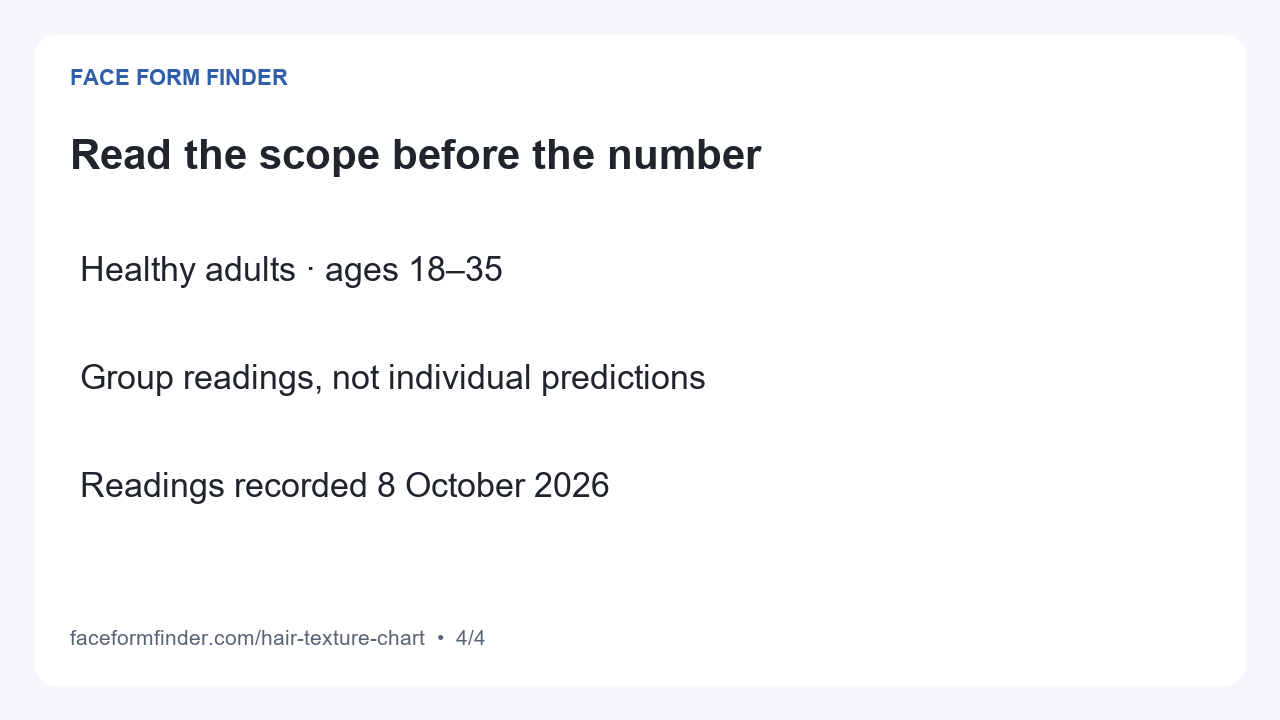
The measured figures above are group averages, not cut-offs: they describe where a group sits, not where any one person must sit, and a person can fall outside their own group’s band. Strand thickness and density are different properties, and both can vary across one head. If you cannot repeat the same observation in several areas and ordinary conditions, record it as mixed or uncertain instead of forcing a label.
This chart is only about strand thickness and scalp coverage. It does not classify natural pattern, measure haircut length, or prescribe a face-shape style.
Read the measured growth-rate figures when the question is how fast hair grows.
Read the resting-phase share by group, and the daily shed worked out from it.
Use the separate page when the question is the shape your hair naturally forms.
Use your own body landmark when choosing an endpoint for a cut.
Open the site hub to find the guide for a face-shape question.
Use the separate chart for face-shape measurement and reading.
Read the dedicated round-face fringe guide.
Read the dedicated oval-face fringe guide.
Carry the strand-thickness and density observations into a perimeter-first layer decision.
If the player does not load, watch it on YouTube: Hair Texture Chart: Strand Diameter Is Not Scalp Density.